
Portfolio site client conversion tips are actionable methods freelancers and entrepreneurs use to turn website visitors into paying clients. Most portfolio sites fail not because the work is weak, but because the site never communicates value fast enough. The two-second test is the industry standard for homepage effectiveness: visitors must understand what you do and who you serve within two seconds or you lose them. Apply the strategies in this guide and your portfolio becomes a client acquisition tool, not just a digital gallery.
What are the best portfolio site client conversion tips for freelancers?
A portfolio site’s conversion rate is defined as the percentage of visitors who take a desired action, such as booking a call or sending an inquiry. Most freelancers treat their portfolio as a showcase. The highest-converting portfolios treat every page as a sales conversation.
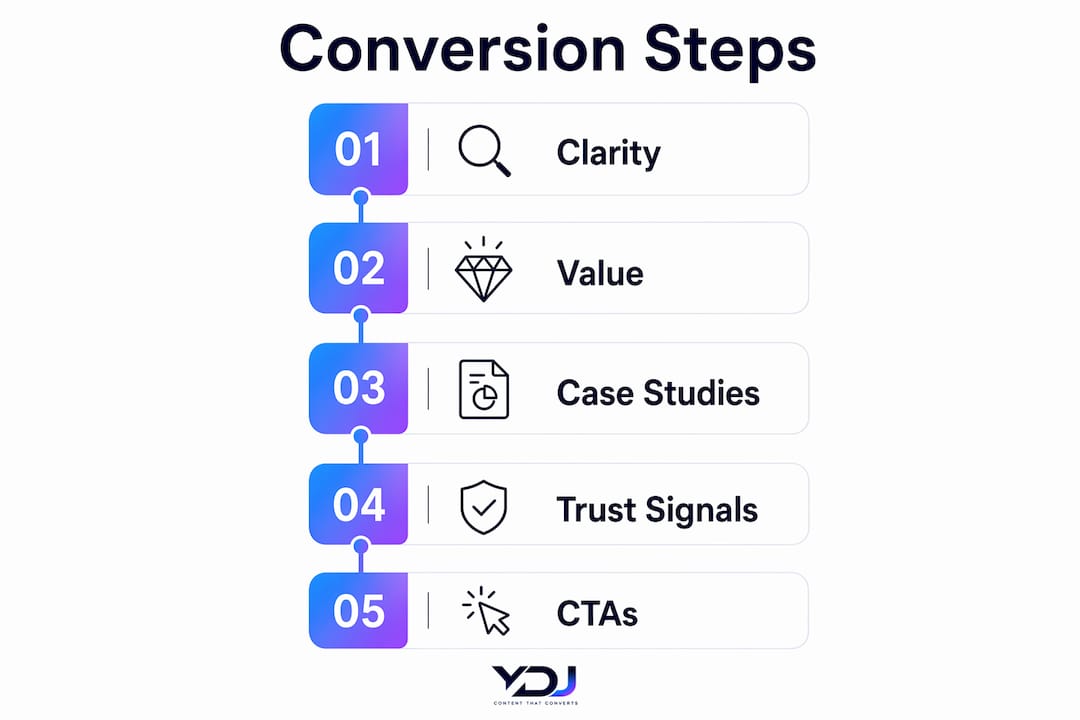
The core insight is simple: clarity converts. Vague headlines, generic taglines, and beautiful-but-confusing layouts all push potential clients away. Your homepage must answer three questions immediately: What do you do? Who do you do it for? What should I do next?

Average attention spans on portfolio landing pages run under eight seconds. That means you have less time than it takes to read this paragraph to prove you are the right fit. Every design decision, every headline, and every CTA must work toward reducing cognitive load and building confidence fast.
How do you write a value proposition that converts on your homepage?
Your value proposition is the single most important sentence on your site. It must be specific, jargon-free, and placed above the fold where visitors see it without scrolling.
Generic phrases like “Creative solutions for modern brands” tell a prospective client nothing. Specific phrases like “Shopify websites for sustainable fashion brands” tell them exactly whether they are in the right place. Specificity filters out bad leads and pulls in good ones. That is the portfolio site client attraction benefit most freelancers overlook.
- Be audience-specific. Name the type of client you serve. “B2B SaaS companies” beats “businesses of all sizes.”
- Be service-specific. State what you actually deliver. “Brand identity design” beats “creative services.”
- Be outcome-specific. Hint at the result. “Websites that book more calls” beats “professional web design.”
- Place it prominently. Your value proposition belongs in the hero section, in large text, above the fold.
Pro Tip: Test your homepage with someone unfamiliar with your work. Ask them to describe what you do after two seconds of viewing. If they cannot, rewrite the headline before anything else.
Reviewing common homepage mistakes is one of the fastest ways to identify what is silently costing you inquiries. Most fixes take less than an hour to implement.
How do case studies help you win clients with your portfolio site?
Case studies are the most persuasive content format on a portfolio site. They show prospective clients not just what you made, but how you think and what results you deliver. A gallery of pretty images creates admiration. A well-structured case study creates trust.
Follow this four-part narrative for every project you feature:
- Problem. Describe the client’s situation before you got involved. Be specific about the challenge.
- Process. Explain your approach and the decisions you made. This shows how you work, not just what you produced.
- Solution. Show the final deliverable with context. Explain why it solves the original problem.
- Result. Quantify the outcome wherever possible. “Increased inquiry rate by 47%” is far more persuasive than “the client was happy.”
Case studies structured as Problem → Process → Solution → Result reduce what researchers call the “anxiety of selection.” Prospective clients feel uncertain when choosing a freelancer. A clear case study removes that uncertainty by showing exactly what working with you looks like.
Visual content inside case studies should support the story, not replace it. Include before-and-after comparisons, process sketches, or screenshots of results alongside your written narrative.
Pro Tip: Add one sentence at the end of each case study that connects the result to a specific client type. Example: “This approach works especially well for e-commerce brands launching a new product line.” That sentence pre-qualifies your next client.
What trust signals actually improve client conversion rates?
Trust signals are the elements on your site that reduce a prospective client’s fear of making the wrong choice. The most effective ones are specific, contextual, and verifiable.
Testimonials that include the client’s name, role, company, and a specific outcome convert far better than anonymous praise. “Great to work with!” tells a prospect nothing. “Working with [you] cut our website bounce rate by 30% in the first month — Sarah Chen, Marketing Director, Bloom Apparel” tells them everything they need to know.
- Use video testimonials when possible. A 60-second video of a real client speaking to their experience builds more trust than any written quote.
- Show your process transparently. A simple timeline or workflow diagram sets expectations and reduces the fear of the unknown.
- Include budget ranges or starting prices. Indicating project investment ranges qualifies leads before they contact you. It saves you time and attracts clients who are already aligned with your pricing.
- Display logos of past clients or brands you have worked with. Visual recognition builds credibility fast.
Transparent processes are underused on freelance portfolio sites. A simple “Here’s how we work together” section with three to five steps removes the friction that stops fence-sitters from reaching out.
Which design elements increase conversion on a portfolio website?
Design is not decoration. Every layout decision either helps a visitor take the next step or gets in their way. The highest-converting portfolio sites share a set of functional design principles that go beyond aesthetics.
Interactive project filters let visitors sort your work by industry, service type, or project scale. This is especially valuable if you serve multiple niches. A retail client browsing your portfolio does not want to scroll past 20 SaaS projects to find relevant examples. Mobile-optimized filters are non-negotiable given how many clients browse on their phones.
Contact options must be multiple and obvious. A single buried contact form is not enough. Combine a contact form with a direct email address and a booking link through a scheduling tool like Calendly. The easier you make it to reach you, the more inquiries you receive.
CTAs must be specific and action-oriented. Specific CTAs like “Book a 15-Minute Discovery Call” outperform generic ones like “Contact Me” because they set a clear, low-commitment expectation. Place a CTA at the end of every case study, in the hero section, and in the navigation.
Track your results. Measure visitor-to-inquiry rates and which portfolio pages get the most engagement. Use that data to refine what you feature and how you present it. Good website design principles make this kind of iteration straightforward.
How do you use SEO to attract qualified clients through your portfolio?
SEO turns your portfolio from a passive showcase into a proactive lead generation tool. Most freelancers ignore it entirely. The ones who get it right attract inbound inquiries without spending on ads.
- Use intent-based, long-tail keywords. Phrases like “SaaS logo design services in Austin” or “e-commerce copywriter for beauty brands” target clients who are actively searching for exactly what you offer. Broad terms like “graphic designer” are too competitive and attract the wrong traffic.
- Add descriptive text to every portfolio page. 200–500 words per portfolio page explaining your approach, location, and client types improve search visibility and attract better leads. Do not let images carry the page alone.
- Write alt text for every image. Descriptive alt text like “brand identity design for sustainable food startup” helps search engines index your work and improves accessibility.
- Create targeted landing pages. A dedicated page for each service or niche you serve ranks better than a single generic portfolio page.
- Use lead magnets. Downloadable guides like “2026 Guide to SaaS Design Trends” capture email addresses and convert one-time visitors into long-term prospects you can nurture over time.
Blog content aligned with client search intent compounds over time. A post titled “How to brief a web designer” attracts business owners at the exact moment they are looking to hire one.
Key Takeaways
A portfolio site converts clients when it communicates value instantly, builds trust through specific social proof, and removes every barrier between a visitor and an inquiry.
| Point | Details |
|---|---|
| Lead with clarity | Your homepage value proposition must pass the two-second test or visitors leave before reading further. |
| Case studies over galleries | Structure every project as Problem, Process, Solution, and Result to reduce client anxiety and build trust. |
| Specific social proof | Testimonials with names, roles, companies, and measurable outcomes convert far better than generic quotes. |
| Functional design choices | Use project filters, multiple contact options, and specific CTAs to reduce friction and increase inquiries. |
| SEO as a lead tool | Add 200–500 words of descriptive text per portfolio page and use long-tail keywords to attract qualified clients. |
What I have learned from building portfolio sites that actually convert
Most freelancers spend 80% of their energy on aesthetics and 20% on conversion. The ratio should be closer to 50/50. A beautiful site that confuses visitors is just an expensive business card.
The biggest shift I have seen in high-performing portfolios is the move away from “look at my work” toward “here is how I solve your problem.” That reframe changes everything: the headlines, the case study structure, the CTA copy, and even which projects you choose to feature.
Aesthetic decisions and conversion decisions are not opposites. Clean design, fast load times, and clear visual hierarchy all serve both goals. The mistake is treating them as separate concerns. When you design with the client’s decision-making process in mind, the site looks better and converts better at the same time.
The freelancers I see struggle most are the ones who build their portfolio once and never touch it again. Your portfolio is a living document. Test a new CTA headline. Swap in a stronger case study. Add a lead magnet. Measure what changes. The freelancers who treat their portfolio as a product they continuously improve are the ones who consistently win better clients.
— Youri
Ydjmedia builds portfolio sites designed to convert
If you have read this far, you already know what your portfolio site needs. The harder part is building it well and building it fast. Ydjmedia specializes in mobile-first websites that are designed from the ground up to convert visitors into clients. You can see your site live before spending a dollar, with a free demo and a 30-day money-back guarantee.
No retainers, no agency runaround, and no surprise fees. Ydjmedia delivers clear, one-time pricing and professional design that puts your value proposition front and center. If your current portfolio is not generating the inquiries your work deserves, that is the problem Ydjmedia solves.
FAQ
What is the two-second test for portfolio sites?
The two-second test is the standard for homepage effectiveness: visitors must understand your services and target clients within two seconds or you risk losing them as leads.
How many case studies should a freelance portfolio include?
Three to five well-structured case studies outperform a large gallery of undescribed images. Quality and clarity matter more than volume.
What makes a CTA effective on a portfolio website?
Specific CTAs like “Book a 15-Minute Discovery Call” convert better than generic ones like “Contact Me” because they set a clear, low-commitment expectation for the prospective client.
Should freelancers show pricing on their portfolio site?
Indicating budget ranges or starting investment levels qualifies leads before they reach out, which reduces unproductive inquiries and attracts clients already aligned with your rates.
How does SEO help a portfolio site generate more leads?
Adding 200–500 words of descriptive text per portfolio page, using long-tail keywords, and creating targeted landing pages makes your site visible to clients actively searching for your specific services.