
Testimonials are authentic customer endorsements that reduce buyer skepticism and accelerate purchase decisions by building trust before a prospect ever speaks to your team. The role of testimonials in conversions is measurable and significant: adding testimonials to landing pages lifts conversion rates by an average of 34%, with B2B SaaS companies seeing up to 58% improvement in trial-to-paid conversions. Text, video, and attributed quote formats each perform differently, and placement matters as much as content. Businesses that treat testimonials as a core conversion tool, not an afterthought, consistently outperform those that treat them as decoration.
How do testimonials build trust and reduce buyer skepticism?
Trust is the single biggest barrier between a prospect and a purchase. When a buyer lands on your page without prior familiarity, their brain is actively looking for reasons to leave. Testimonials short-circuit that instinct by providing third-party confirmation that your product or service delivers what it promises.
The psychological mechanism here is social proof. Buyers assume that if other people like them found value, they will too. That assumption reduces what researchers call cognitive friction, the mental resistance that slows or stops a decision. A well-placed testimonial does not just reassure; it removes a specific objection before the buyer even forms it consciously.
Attribution is what separates a credible testimonial from a useless one. Anonymous or generic testimonials harm trust more than having none at all. Full attribution, meaning a real name, photo, job title, and company, signals that a real person stands behind the claim. Adding real customer photos increases perceived authenticity by 35% compared to text-only quotes. The human face acts as a trust catalyst, reducing cognitive friction and elevating credibility at a glance.
Matching testimonials to your audience profile amplifies their effect further. A testimonial from a solo consultant means little to a 50-person manufacturing firm. Segment your testimonials by industry, company size, or use case and surface the most relevant one to each visitor. Relevance multiplies trust.
- useful attribution always. Name, photo, title, and company are non-negotiable for credibility.
- Match testimonials to audience segments. A retail owner responds to a retail testimonial, not a generic one.
- Address the specific fear. If buyers worry about setup time, find a customer who mentions it directly.
- Avoid stock photos. Real, slightly imperfect photos outperform polished headshots in authenticity tests.
Pro Tip: Ask customers for a LinkedIn profile link alongside their testimonial. Linking their name to a real professional profile adds a layer of verifiability that no stock photo can replicate.
Which testimonial formats and placements yield the highest conversion rates?
Format and placement are the two variables most businesses get wrong. They collect great testimonials and then bury them where no one converting will ever see them.
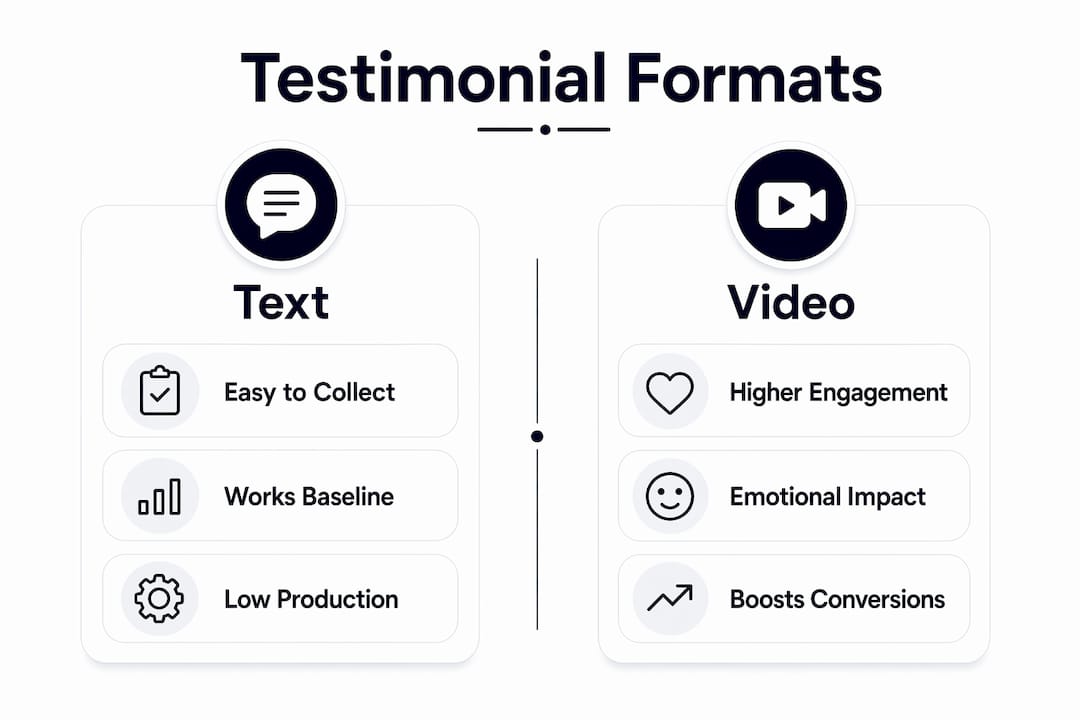
Text vs. video testimonials
Text testimonials are the baseline. They are easy to collect, easy to display, and they work. Video testimonials work harder. Video testimonials increase conversion rates by up to 80% compared to text-only formats because they carry emotional resonance and perceived authenticity that text cannot replicate. A buyer watching a real person describe their experience activates empathy in a way that reading a quote simply does not. For businesses selling higher-ticket services, video is worth the production investment. Ydjmedia builds video content specifically for this purpose, helping businesses capture and present customer stories that convert.

Static displays vs. rotating carousels
Auto-rotating testimonial carousels feel dynamic but perform poorly. Static testimonial displays outperform auto-rotating carousels because they let prospects read at their own pace. When a carousel rotates before a reader finishes, it creates frustration, not trust. Use static grids or stacked layouts instead. If you have many testimonials, let the user scroll or click to load more rather than rotating automatically.
Placement near decision points
Placement is where most businesses leave conversion gains on the table. Testimonials buried in About or footer pages do little to drive conversions. The highest-impact locations are directly adjacent to calls to action, pricing tables, and checkout forms. These are the exact moments when buyer anxiety peaks. A testimonial placed next to a “Start Free Trial” button answers the unspoken question: “Did this actually work for someone like me?” Testimonials placed adjacent to CTAs increase click-through rates by 22%.
| Format | Placement | Conversion Impact |
|---|---|---|
| Text with full attribution | Next to CTA button | Moderate to high |
| Video testimonial | Above the fold or pricing section | Up to 80% lift vs. text only |
| Static quote grid | Pricing page or checkout | High engagement, low friction |
| Auto-rotating carousel | Anywhere | Lower engagement than static |
| Anonymous text quote | Footer or About page | Minimal to negative impact |
Pro Tip: Test one testimonial directly inside your checkout flow, right above the final purchase button. This is the highest-anxiety moment in any buyer journey, and a single well-chosen quote can recover hesitant buyers at the last second.
What makes a testimonial effective at overcoming buyer objections?
Not all testimonials convert equally. The difference between a testimonial that moves a buyer and one that gets ignored comes down to specificity and outcome focus.
Generic praise like “Great product!” signals nothing. Outcome-focused and quantified testimonials are 63% more persuasive than vague statements. A testimonial that says “We reduced our onboarding time by three weeks after switching” gives a prospect something concrete to evaluate. It answers the question: “What will I actually get?” Generic praise does not answer that question.
Testimonials that address specific conversion objections, such as ease of setup, return on investment, or reliability, are 45% more effective than general endorsements. Before-and-after storytelling is the most powerful structure. A testimonial that describes the problem, the switch, and the measurable result mirrors the buyer’s own mental journey and makes the outcome feel real and attainable.
The challenge is that most customers, left to their own devices, write generic praise. Guided interviews fix this. Ask specific questions that pull out the story:
- What problem were you trying to solve before you found us?
- What made you hesitant to move forward at first?
- What specific result did you see after using our product or service?
- How would you describe the experience to a colleague in your industry?
- What would you tell someone who is on the fence about working with us?
These five questions produce testimonials with narrative structure, specific outcomes, and objection handling built in. That is the content that converts. Avoid over-polishing the responses. Testimonials that sound too perfect read as manufactured. Light editing for clarity is fine; rewriting the voice entirely destroys authenticity.
Pro Tip: Record your customer interviews on video even if you plan to use only the text. You now have both a video testimonial and a written one from the same conversation, doubling your content output from a single session.
How can businesses integrate testimonials across marketing channels?
Collecting strong testimonials is only half the job. Distributing them strategically across your marketing channels is where the conversion impact compounds.
Landing pages are the primary battlefield. Each landing page should feature at least one testimonial that speaks directly to the audience segment that page targets. A page targeting e-commerce businesses should not feature a testimonial from a law firm. Segment and match. For converting leads with testimonials on professional service pages, pairing a testimonial with a case study link creates a one-two punch of social proof and evidence.
Pricing pages deserve special attention. This is where buyers calculate risk. A testimonial that mentions ROI or cost savings placed directly on the pricing page addresses the most common objection at the exact moment it arises. Checkout pages follow the same logic. One well-placed quote above the final action button can recover buyers who are about to abandon.
- Segment testimonials by audience type. Match the testimonial persona to the page visitor.
- Pair testimonials with case studies. Testimonials create emotional trust; case studies provide rational proof.
- Use testimonials in paid ads. A short video testimonial clip used as an ad creative outperforms most brand-produced ad formats.
- Avoid testimonial overload. Three strong, specific testimonials outperform fifteen generic ones on any single page.
- In B2B sales, use testimonials as internal tools. Outcome-specific testimonials help internal champions justify purchases to decision-makers, reducing final objections and increasing win rates.
Paid social and email campaigns are underused channels for testimonials. A short customer quote in an email subject line or a video clip in a Facebook ad introduces social proof at the awareness stage, before a prospect even reaches your website. This primes trust early and shortens the decision cycle once they arrive. For businesses investing in video content for conversions, testimonial clips are among the highest-return assets you can produce.
Key takeaways
Testimonials drive conversions by reducing buyer skepticism at the exact moments when purchase anxiety is highest, and format, attribution, and placement determine whether that impact is significant or negligible.
| Point | Details |
|---|---|
| Attribution is non-negotiable | Full name, photo, title, and company increase credibility by 35% over anonymous quotes. |
| Video outperforms text | Video testimonials can lift conversions by up to 80% compared to text-only formats. |
| Placement near CTAs wins | Testimonials adjacent to calls to action increase click-through rates by 22%. |
| Specificity drives persuasion | Outcome-focused testimonials are 63% more persuasive than generic praise. |
| Segment for relevance | Matching testimonials to the audience profile on each page multiplies their conversion impact. |
Why I think most businesses are wasting their best testimonials
After working with businesses across industries, the pattern I see most often is this: a company has genuinely great customer feedback sitting in their inbox or Google reviews, and they paste one or two lines onto an About page and call it done. That is not a testimonial strategy. That is a missed opportunity.
The businesses that see real conversion lifts treat testimonials as storytelling assets. They invest time in guided interviews. They ask the uncomfortable questions: “What almost stopped you from buying?” and “What would you tell a skeptic?” Those answers produce the kind of content that makes a hesitant buyer feel seen and understood.
I have also noticed that volume is a trap. Businesses chase quantity, collecting dozens of short, vague quotes, when three deeply specific testimonials would do far more work. One testimonial that walks through a real transformation, with a name, a face, and a number attached, is worth more than twenty lines of “Highly recommend!”
The format question is also worth revisiting regularly. Buyer behavior shifts. What worked in 2023 may underperform in 2026. Test video against text. Test static grids against single featured quotes. The homepage mistakes that cost businesses clients often come down to treating testimonials as static content rather than a living, testable part of the conversion system. Treat your testimonials like you treat your ads: run them, measure them, and improve them.
— Youri
How Ydjmedia helps businesses turn testimonials into conversion assets
Testimonials only convert when they are presented well. A poorly designed testimonial section, no matter how strong the quotes, loses buyers to visual clutter or misplaced trust signals.
Ydjmedia builds mobile-first websites specifically designed to convert visitors into customers, with testimonial sections placed where they do the most work: next to CTAs, on pricing pages, and inside checkout flows. The team also produces video content that captures real customer stories in a format that builds trust faster than any written quote. With clear, one-time pricing, a free demo site before any financial commitment, and a 30-day money-back guarantee, Ydjmedia removes the risk from getting started. See what a conversion-focused website looks like for your business.
FAQ
How much do testimonials increase conversion rates?
Adding testimonials to landing pages increases conversion rates by an average of 34%, with B2B SaaS companies seeing up to 58% improvement in trial-to-paid conversions.
Where should testimonials be placed for maximum impact?
Testimonials placed directly adjacent to CTAs, pricing tables, and checkout forms deliver the highest conversion impact. Testimonials buried on About or footer pages have minimal effect on conversions.
Do video testimonials outperform written ones?
Yes. Video testimonials increase conversions by up to 80% compared to text-only formats because they carry stronger emotional resonance and perceived authenticity.
What makes a testimonial actually persuasive?
Specificity and outcome focus. Testimonials that address real objections and quantify results are 45% more effective than generic praise, and outcome-focused quotes are 63% more persuasive than vague endorsements.
Should I use a rotating carousel for testimonials?
No. Static testimonial displays outperform auto-rotating carousels because they let buyers read at their own pace without interruption or frustration.