
Website conversion optimization tips are practical, tested strategies that increase the percentage of visitors who complete a desired action on your site, whether that’s booking a call, making a purchase, or filling out a form. The industry term for this discipline is conversion rate optimization, or CRO. CRO is a data-driven, iterative process focused on identifying friction points, forming hypotheses, deploying changes, and measuring results continuously. For small business owners, that means more revenue from the traffic you already have. This guide covers the most effective entrepreneur website conversion tips for 2026, grounded in real data from HubSpot, Shopify, and SiteGrade.
1. Website conversion optimization tips start with your value proposition
Your value proposition is the single most important line on your website. Visitors decide within seconds whether your site is worth their time. Clarity and trust above the fold are the two highest-impact CRO factors, according to HubSpot’s 2026 guidance. If a visitor cannot immediately understand what you do and why it matters to them, they leave.

A strong value proposition answers three questions at a glance: What do you offer? Who is it for? Why should they choose you over anyone else? Keep it benefit-driven, not feature-driven. “We build mobile-first websites that convert visitors into customers” beats “We offer web design services” every time.
Social proof reinforces your value proposition at the exact moment a visitor is deciding. Place testimonials, star ratings, or client logos near your primary call-to-action (CTA). Reviews placed at decision points, not just on a dedicated testimonials page, tip fence-sitters into customers.
- Put your clearest benefit statement in the hero section, above the scroll line
- Use real client names and photos with testimonials, not anonymous quotes
- Add trust badges (SSL, money-back guarantee, industry certifications) near purchase or inquiry buttons
- Write CTAs in first-person commitment language: “Get my free quote,” outperforms “Submit”
Pro Tip: Test your value proposition by reading it aloud to someone unfamiliar with your business. If they cannot explain your offer back to you in one sentence, rewrite it.
2. Site speed is a conversion lever, not just a technical metric
Page speed directly controls whether visitors stay or leave. When LCP (Largest Contentful Paint) is under 1.5 seconds, the median conversion rate is 3.8%. At 4–6 seconds, that rate drops to 1.5%. Beyond 6 seconds, it falls to 0.7%. That is not a minor difference. It is the gap between a profitable site and a failing one.
Core Web Vitals, which include LCP, INP (Interaction to Next Paint), and CLS (Cumulative Layout Shift), are causal factors in your conversion funnel, not just SEO checkboxes. Poor Core Web Vitals can cost 15–40% of conversions on average. That revenue loss compounds every single day your site stays slow.
The fastest wins come from a few targeted technical changes:
- Convert images to AVIF or WebP format to reduce file size without quality loss
- Add explicit width and height dimensions to all media elements to prevent layout shifts
- Defer non-critical JavaScript so the page renders before scripts load
- Use a content delivery network (CDN) to serve assets from servers closer to your visitors
Pro Tip: Run a speed audit on your three highest-traffic pages first. Prioritizing LCP improvements on those pages delivers more conversion gain than fixing every page at once.
3. Mobile experience determines whether you win or lose the sale
More than half of web traffic comes from mobile devices. A site that looks great on a desktop but breaks on a phone loses those visitors permanently. Mobile responsiveness is not optional for entrepreneur website must-haves in 2026. It is the baseline.
Mobile visitors also make decisions faster than desktop users. Live chat and clear FAQs reduce friction and capture conversions during the short attention window visitors give your site. A visitor on a phone who cannot find your phone number or service area within seconds will call your competitor instead.
Test your site on actual mobile devices, not just a browser’s responsive preview. Check that buttons are large enough to tap, forms are easy to complete with a thumb, and your CTA is visible without scrolling. Every extra tap or scroll you remove increases the chance of a conversion.
4. Build a landing page that does one job
A landing page with one clear goal converts better than a general page trying to do everything. The best practices for website conversion on landing pages follow a simple hierarchy: headline, subheadline, benefit list, social proof, and CTA. Every element on the page should support that single goal.
Remove your main navigation menu from dedicated landing pages. Navigation gives visitors an exit ramp. On a page built to capture leads or sell a service, you want visitors to read and act, not browse. This single change consistently lifts conversion rates on paid traffic campaigns.
Keep forms short. Every additional field you add reduces completions. Ask only for what you need to take the next step. Name and email, or name and phone, is enough for most service businesses. You can collect more information after the first contact is made.
5. Write CTAs that remove hesitation
Most CTAs fail because they ask for too much commitment too soon. “Buy now” on a first visit from a cold visitor rarely works. A CTA that matches where the visitor is in their decision process converts far better. “See how it works” or “Get a free demo” asks for less commitment and gets more clicks.
Button color matters less than button clarity. The CTA must stand out visually from the rest of the page, but the words on it do the real work. Use specific, action-oriented language that tells the visitor exactly what happens next. “Book a 15-minute call” is more compelling than “Contact us” because it sets clear expectations.
Place your primary CTA above the fold and repeat it at the bottom of the page. Visitors who read to the end are your most interested prospects. Give them an easy way to act right where they finish reading.
6. Use data to find what is actually broken
You cannot fix what you cannot measure. Shopify’s 2026 CRO guide describes the optimization cycle as: calculate your baseline conversion rate, form a hypothesis, run a test, measure results, and iterate. Skipping the baseline step is the most common mistake small business owners make.
Before running any test, audit your analytics setup. Duplicate GA4 conversion events lead to inflated data and incorrect conclusions. Use Google Tag Manager Preview or Tag Assistant to verify that each conversion event fires exactly once per genuine completion. Bad data produces bad decisions, and bad decisions waste your budget.
A practical CRO audit covers these steps in order:
- Verify live data is flowing into GA4 correctly
- Confirm conversion events are configured and firing without duplication
- Link Google Search Console to GA4 for organic traffic context
- Remove any duplicate tracking scripts from your site
- Add a heatmap tool to capture where visitors click and scroll
- Confirm mobile conversion tracking is active and accurate
Pro Tip: Heatmaps and session recordings show you what visitors actually do, not what you assume they do. They reveal friction points that no spreadsheet will surface.
7. Run A/B tests the right way
A/B testing is the core engine of CRO, but most small business owners run tests incorrectly. The most common mistake is stopping a test too early because one variant looks like it is winning. A/B tests require adequate run length based on sample size and minimum detectable effect. Ending early produces unreliable results that can send you in the wrong direction.
Predefine your statistical parameters before the test starts. Set your minimum detectable effect (the smallest improvement worth acting on), your desired statistical power, and your acceptable error rate. Then calculate how long the test needs to run to collect enough data. Do not let impatience override the math.
Bayesian and frequentist testing methods both work, but they require different approaches. Frequentist A/B testing requires pre-registered sample sizes and error rates set before the test begins. Bayesian methods offer more flexibility in interpretation but require careful design to avoid misuse. For most small business teams, a simple frequentist approach with a pre-calculated sample size is the most practical starting point.
8. Optimize navigation to guide visitors toward conversion
Confusing navigation kills conversions silently. Visitors who cannot find what they need do not ask for help. They leave. Your navigation should create a clear path from arrival to action, with no dead ends and no guesswork.
Limit your main menu to five or six items. Every additional option splits attention and slows decisions. Group related pages under clear parent labels. Use descriptive labels like “Services” and “Get a Quote” rather than clever or branded names that visitors have to decode.
Your most important conversion page, whether that is a contact form, a booking page, or a product page, should be reachable in one click from anywhere on your site. If a visitor has to hunt for it, you will lose them before they get there.
Key Takeaways
The most effective approach to website conversion optimization combines a clear value proposition, fast page speed, accurate data tracking, and disciplined A/B testing to produce compounding conversion gains over time.
| Point | Details |
|---|---|
| Value proposition first | State your clearest benefit above the fold before testing anything else. |
| Speed drives revenue | LCP under 1.5 seconds correlates with a 3.8% median conversion rate; fix speed before copy. |
| Audit your data | Duplicate GA4 events corrupt test results; verify tracking before running any experiment. |
| Test with discipline | Predefine sample size and run length before starting any A/B test to avoid false conclusions. |
| Reduce friction everywhere | Short forms, clear CTAs, and fast mobile load times each remove barriers between visitors and conversions. |
What I have learned after building dozens of small business sites
The biggest mistake I see entrepreneurs make is jumping straight to button colors and font changes. Those tweaks feel productive, but they rarely move the needle. Every site I have worked on that saw a real conversion lift started with the same two fixes: a clearer value proposition and a faster load time. Everything else came after.
The second pattern I keep seeing is broken analytics. Owners run A/B tests on data they trust, but the data is wrong. Duplicate conversion tags, misconfigured GA4 events, and missing mobile tracking are more common than most people realize. I always audit the analytics setup before touching a single page element. You cannot make good decisions from bad numbers.
My honest advice: resist the urge to test everything at once. Pick the one change most likely to reduce friction for your specific visitor, run it properly with a pre-calculated sample size, and measure it cleanly. One well-run test beats ten sloppy ones. The homepage mistakes costing you clients are almost always structural, not cosmetic. Fix the structure first, then refine the details.
CRO is not a one-time project. It is a habit. The entrepreneurs who win are the ones who build a rhythm of measuring, testing, and improving every quarter.
— Youri
How Ydjmedia helps small businesses convert more visitors
Getting your website to convert takes more than good intentions. It takes a site built with conversion in mind from the first line of code. Ydjmedia builds mobile-first websites designed specifically to turn visitors into paying customers, with clear value propositions, fast load times, and CTAs that actually work.
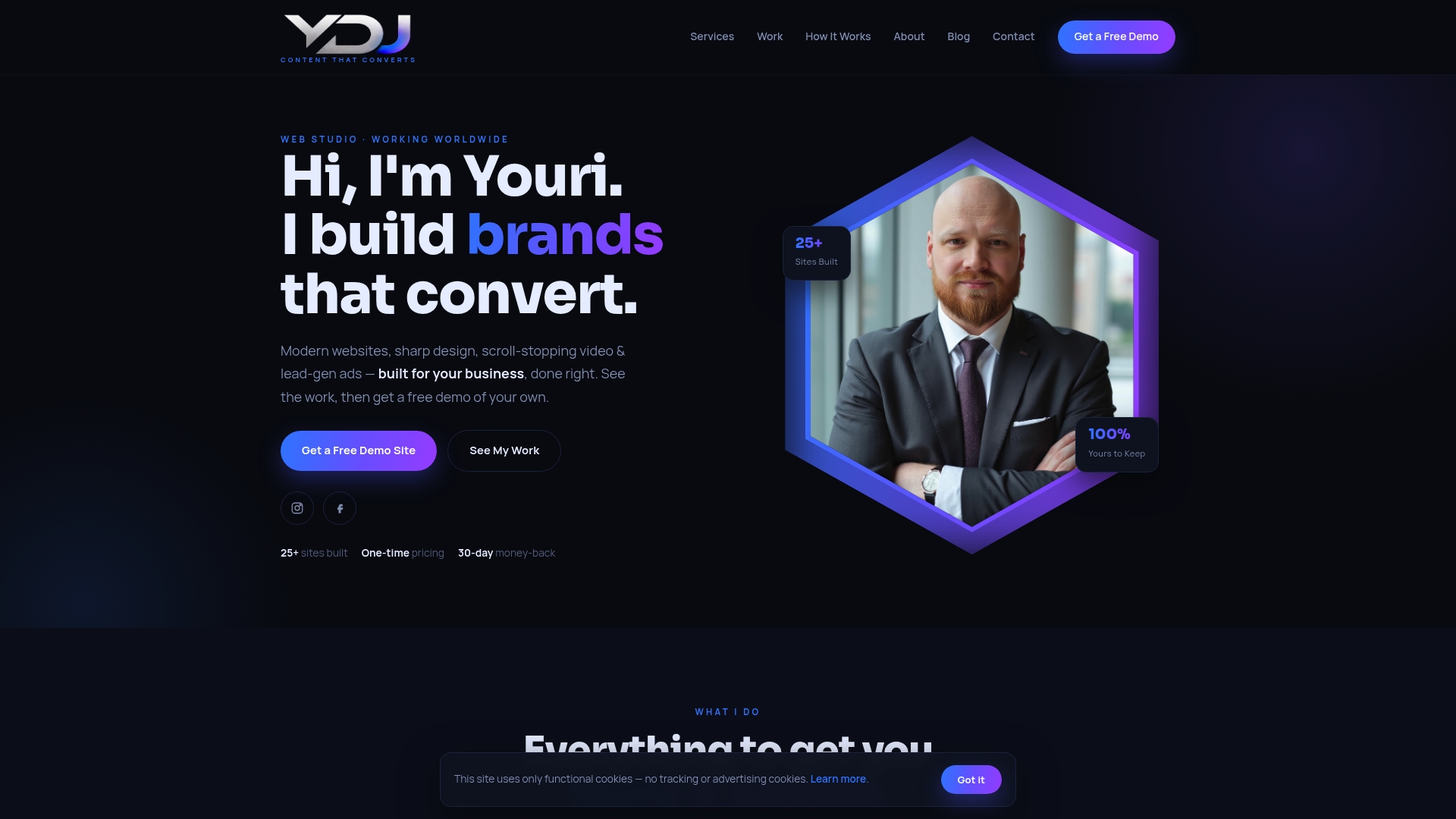
Every Ydjmedia project starts with a free demo site so you can see exactly what your website will look like before spending a dollar. There are no retainers, no agency runaround, and no surprise fees. You get one-time pricing, a 30-day money-back guarantee, and a site built to perform. If you are ready to stop losing visitors and start converting them, see what Ydjmedia builds for small businesses like yours.
FAQ
What is conversion rate optimization (CRO)?
CRO is the process of increasing the percentage of website visitors who complete a desired action, such as making a purchase or submitting a form. It uses data, testing, and UX improvements to reduce friction and improve results without increasing ad spend.
How fast does my website need to be to convert well?
An LCP (Largest Contentful Paint) under 1.5 seconds correlates with a median conversion rate of 3.8%. Sites that load in 4–6 seconds drop to a 1.5% conversion rate, making speed one of the highest-priority fixes for any small business site.
How long should I run an A/B test?
Run your test until you reach the sample size calculated before the test began, based on your minimum detectable effect and desired statistical power. Stopping early because one variant looks better produces unreliable results.
What should I fix first on my website to improve conversions?
Start with your value proposition and site speed. These two factors have the highest impact on whether visitors stay and act. Audit your analytics setup next to confirm your data is accurate before running any tests.
Do I need a separate landing page for each offer?
A dedicated landing page with one goal, no navigation menu, and a single CTA consistently outperforms a general page for paid traffic and specific campaigns. For most small businesses, one focused landing page per core service or offer is the right starting point.