
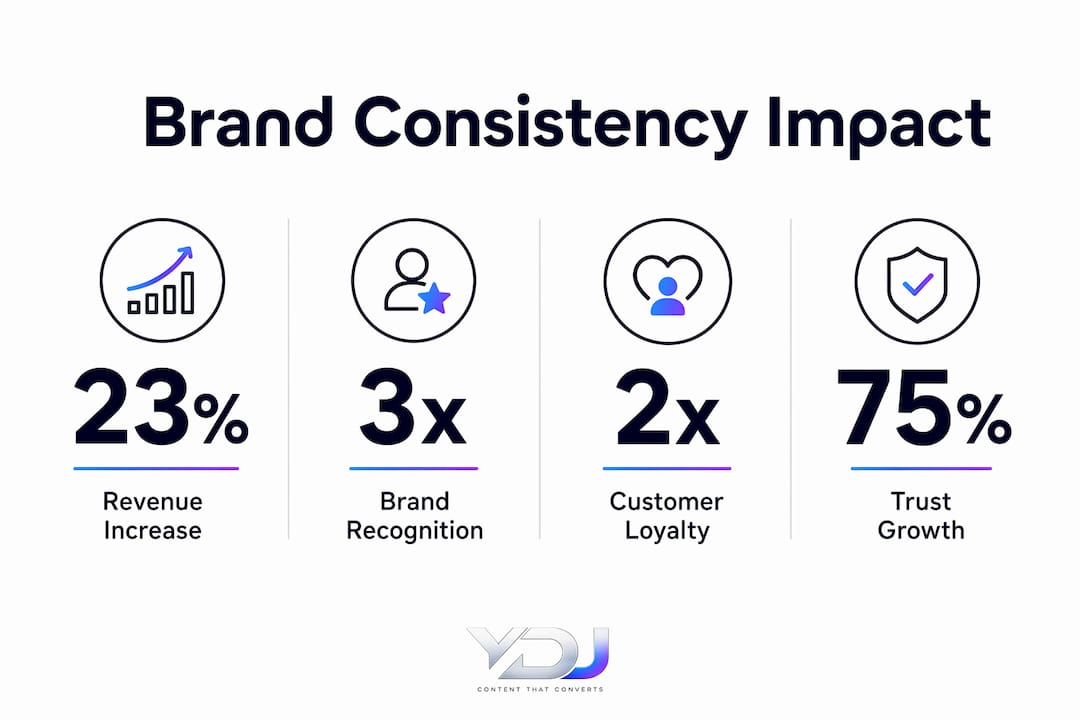
Consistent branding online is the practice of presenting your business’s visual and verbal identity uniformly across every digital platform to build immediate recognition and trust. This is not a design preference. It is a revenue strategy. Consistent brand presentation across all platforms can increase a business’s revenue by up to 23%. That number comes from Lucidpress research, and it reflects a simple truth: customers buy from brands they recognize and trust. For business owners and marketers, understanding why consistent branding online matters is the first step toward building a digital presence that actually converts.
What measurable impact does consistent branding have on business success?
The numbers behind brand consistency are hard to ignore. Companies maintaining brand consistency average 10–20% more revenue than competitors who do not. That gap compounds over time, because every touchpoint either reinforces or erodes the impression your business makes.
First impressions happen fast. Website credibility judgments form in just 50 milliseconds, before a visitor reads a single word. That means your logo placement, color palette, and typography are doing the selling before your copy even gets a chance. A mismatched font or an off-brand color on a landing page can quietly kill conversions without you ever knowing why.
“Brand trust is the most critical factor for competitive advantage in the online era. Consistent communication across digital channels is the mechanism that builds it.”
Journal of Research in Business and Management, 2026
Customer loyalty follows trust. Brand consistency builds familiarity, reduces cognitive load, and increases customer confidence in online businesses. When customers recognize your brand instantly, they spend less mental energy deciding whether to trust you. That freed-up attention goes toward the decision to buy.
| Metric | Impact of Brand Consistency |
|---|---|
| Revenue increase | Up to 23% from consistent brand presentation |
| Revenue vs. competitors | 10–20% higher for consistent brands |
| First impression window | 50 milliseconds to establish credibility |
| Trust factor | Ranked #1 competitive advantage in digital markets |
Pro Tip: Run a quick audit. Open your website, your most recent email, and your top social profile side by side. If they look like they belong to three different companies, you have a consistency problem worth fixing today.
Which brand elements must stay consistent online?
Visual identity is the most visible layer of your brand. Your logo, color palette, and typography must appear the same way across your website, social media profiles, email campaigns, and digital ads. A two-tone color scheme that shifts between platforms signals disorganization, even if your product is excellent.

Verbal identity matters just as much. Your tone of voice, the words you use, and the promises you make in your messaging must stay aligned. A brand that sounds confident and direct on its website but vague and corporate in its emails creates confusion. Customers notice the gap, even if they cannot name it.
Here are the core elements every business must keep consistent across all digital channels:
- Logo: Use one approved version. Avoid stretching, recoloring, or substituting alternate versions without a clear brand rule.
- Color palette: Limit to 2–3 primary brand colors. Apply them the same way on every platform.
- Typography: Choose one or two typefaces and use them consistently in headings, body text, and CTAs.
- Tone of voice: Define whether your brand is formal, conversational, or somewhere in between. Write every piece of content to that standard.
- Messaging: Your core value proposition must read the same way whether a customer finds you through Google, Instagram, or a referral link.
- Templates: Use standardized layouts for social posts, email headers, and ad creatives so every asset looks like it belongs to the same family.
Consistency across these elements builds familiarity. Familiarity reduces the mental effort customers need to trust you. That psychological shortcut is exactly what turns a first-time visitor into a paying customer. A well-designed website that matches your brand across every element is one of the most direct ways to make that happen.
Pro Tip: Create a one-page brand reference sheet with your exact hex color codes, font names, and logo file links. Share it with anyone who creates content for your business, including freelancers and social media managers.
What are the common pitfalls in maintaining online brand consistency?
The most expensive mistake business owners make is confusing a brand problem with a marketing problem. Marketing failures often signal brand clarity issues rooted in inconsistent or vague identity, not weak promotional tactics. Running more ads on a brand that customers cannot recognize is like pouring water into a leaky bucket.
Here are the most common pitfalls to avoid:
-
Rebranding too often. Startups that pivot frequently and rebrand during scaling phases lose brand recognition and customer trust. Every rebrand resets the familiarity your customers have built with you. Reserve rebranding for genuine strategic shifts, not aesthetic boredom.
-
Copying competitors. Borrowing visual styles from successful brands in your industry feels safe but produces the opposite result. Customers cannot distinguish you from the competition, and you lose the one thing that drives preference: a distinctive identity.
-
Overdesigning brand assets. Complex logos, too many colors, and ornate typography are harder to reproduce consistently across platforms. Simplicity scales. Complexity breaks.
-
Underinvesting in brand foundations. Skipping a proper brand setup to save money early almost always costs more later. A minimal viable brand includes a logo, 2–3 colors, one typeface, a positioning statement, and basic templates for key formats. That is enough to stay consistent while you grow.
-
Letting individual team members improvise. Without shared guidelines, every person who creates content for your business makes their own decisions. The result is a fragmented brand that looks different every week.
Recognizing these traps early saves you from the costly process of rebuilding trust after it has eroded. The homepage mistakes that cost you clients are often rooted in exactly these consistency failures.
How can you implement and maintain brand consistency online?
Building brand consistency is a system, not a one-time project. The businesses that get it right treat their brand like a product: they document it, maintain it, and improve it based on feedback.
Start with a brand guidelines document. This does not need to be a 50-page PDF. A clear, practical reference covering your logo rules, color codes, typography, tone of voice, and messaging framework is enough to align your team and any external partners.
- Appoint a brand owner. Someone on your team must be responsible for brand consistency. Without accountability, standards drift.
- Use templates for every repeating format. Social posts, email headers, proposal covers, and ad creatives should all have locked-down templates. This removes guesswork and speeds up production.
- Audit your digital presence quarterly. Check your website, social profiles, email signatures, and any paid ads. Look for outdated logos, off-brand colors, or messaging that no longer reflects your positioning.
- Gather audience feedback. Ask customers how they describe your brand. If their language does not match yours, your messaging has a gap.
- Apply consistency to video content. Video is one of the fastest-growing content formats. Consistent branding in video builds the same recognition benefits as static assets, and it deepens emotional connection with your audience.
The table below shows the difference between a reactive and a proactive approach to brand management:
| Approach | Reactive | Proactive |
|---|---|---|
| Brand guidelines | Created after problems appear | Documented before launch |
| Asset creation | Improvised per project | Built from approved templates |
| Brand review | When something looks wrong | Scheduled quarterly audit |
| Team alignment | Assumed | Trained and documented |
| Customer feedback | Collected occasionally | Monitored and integrated regularly |
The proactive column is not more work. It is less work over time, because you stop fixing inconsistencies after the fact. Conversion optimization depends heavily on this kind of brand discipline, because trust is what turns traffic into revenue.
Key Takeaways
Consistent online branding is the single most reliable way to build customer trust, increase recognition, and drive measurable revenue growth across every digital channel.
| Point | Details |
|---|---|
| Revenue impact | Consistent branding increases revenue by up to 23%, per Lucidpress research. |
| First impressions | Credibility judgments form in 50 milliseconds, before any copy is read. |
| Core elements | Logo, colors, typography, tone, and messaging must align across all platforms. |
| Common pitfall | Frequent rebranding destroys recognition. Build a minimal viable brand and hold it. |
| Implementation | Document brand guidelines, use templates, and assign a brand owner to maintain standards. |
Why I think most businesses underestimate brand consistency
I have worked with enough small business owners to see the same pattern repeat. They invest in ads, hire a copywriter, and redesign their website, but nothing sticks. The real issue is almost always the same: their brand looks and sounds different depending on where a customer finds them.
The research backs this up. AI-driven content production is making polished digital assets easier to create than ever. That means the bar for looking professional is rising fast. A consistent identity is now the true differentiator, not just a nice-to-have.
What I find most underappreciated is the compounding effect. Every time a customer sees your brand presented consistently, it adds a small deposit to their trust account with you. Over dozens of touchpoints, that account grows into genuine loyalty. Inconsistency makes withdrawals from that same account, often without you noticing until a customer chooses a competitor instead.
The businesses that win long-term are not the ones with the biggest budgets. They are the ones that show up the same way, every time, across every channel. That discipline is harder than it sounds, but the payoff is a brand that customers recognize, remember, and recommend.
— Youri
How Ydjmedia helps you build a brand that converts
Building a consistent brand online takes more than good intentions. It takes a website, design assets, and content that all work together from day one.
Ydjmedia builds modern, mobile-first websites designed to convert visitors into customers, with design, video, and ad creative that stay on-brand across every channel. The process starts with a free demo site, so you see exactly what your brand looks like online before spending a dollar. There are no retainers, no runaround, and no surprises. Just clear pricing and a 30-day money-back guarantee. If you are ready to build a consistent digital presence that earns trust and drives real results, Ydjmedia is built for exactly that.
FAQ
What is consistent branding online?
Consistent branding online is the practice of presenting the same visual and verbal identity across every digital platform, including your website, social media, emails, and ads. It builds recognition and trust with customers over time.
How does brand consistency increase revenue?
Consistent brand presentation can increase revenue by up to 23%, according to Lucidpress research. Customers trust recognizable brands more and are more likely to buy from them repeatedly.
What are the most important elements of a consistent brand?
The core elements are your logo, color palette, typography, tone of voice, and core messaging. These must appear the same way across every digital channel your business uses.
Why do startups struggle with brand consistency?
Startups often rebrand too frequently during growth phases, which resets customer familiarity and erodes trust. A minimal viable brand with a logo, 2–3 colors, one typeface, and a positioning statement provides enough consistency to scale without constant overhauls.
How often should you audit your online brand consistency?
A quarterly audit of your website, social profiles, email templates, and paid ads is enough to catch and correct inconsistencies before they damage customer trust.