
A personal brand website is a strategic platform designed to showcase your unique professional story and convert visitors into meaningful connections or clients. Unlike a social media profile, your website is the one digital asset you fully own and control. The right personal brand website strategy combines identity clarity, content planning, and conversion-focused design into a single, cohesive system. This guide walks you through every step, from defining who you are to measuring what works, so you can build a site that actually grows your career or business.
Why identity clarity is the foundation of your personal brand website strategy
Your personal brand website fails before it launches if you skip identity work. The Harvard 7-step personal branding framework puts identity questions first: who are you, how do others perceive you, and what makes you different? Skipping this step leads to inconsistent messaging and brand drift that costs months of rework later.
Identity clarity means answering three questions before you write a single word of site copy:
- Who are you? Define your professional role, values, and the specific expertise you bring.
- Who do you help? Name the exact person or business you serve best.
- What is your unique value proposition? State the specific outcome you deliver that others do not.
These answers shape every page, headline, and call to action on your site. Without them, your homepage becomes a vague collection of skills rather than a clear invitation to work with you.
Pro Tip: Before opening any website builder, write your answers to those three questions in a plain text document. Read them out loud. If a stranger could not understand your value in 10 seconds, rewrite until they can.

What are the essential elements of an effective personal brand website?
A personal brand website needs specific sections to build trust and drive action. Missing even one of these creates friction that pushes visitors away.
Homepage
Your homepage must state who you are, who you help, and what visitors should do next, all within the first screen. A clear headline, a supporting subheadline, and one primary CTA button are the minimum. Every page element should either build trust or move a visitor closer to a decision.
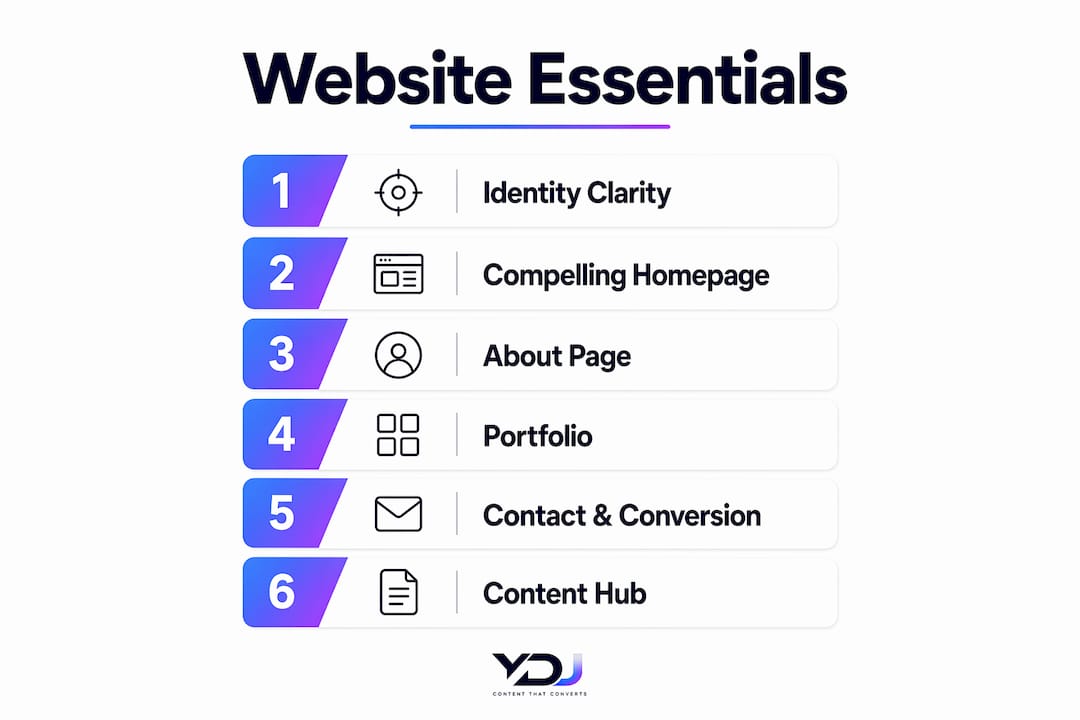
About page
The about page is your most-read page after the homepage. Treat it as a personal story that builds trust, not a resume or a list of credentials. Readers want to know why you do what you do, not just what certifications you hold.
Portfolio or proof section
Feature 3–7 high-impact examples with clear outcomes and client testimonials. Vague case studies do not convert. Specific results, such as “increased organic traffic by 40% in 90 days,” do.
Contact and conversion pages
A simple contact form or booking link removes friction. Your lead capture page, often a free download or email opt-in, is the highest-value conversion asset on your site. Most personal brand sites underinvest here, and it shows in their subscriber numbers.
Content hub
A blog, podcast archive, or newsletter page signals ongoing expertise. Without fresh content, AI search tools stop citing you and your search visibility drops over time.
Pro Tip: Keep your navigation menu to 5–9 clearly labeled items. Lean navigation reduces decision fatigue and keeps visitors moving toward your CTA instead of wandering.
One technical detail most personal brand creators miss: add “Person” schema markup to your homepage and about page. Person schema markup tells AI search engines exactly who you are and what you specialize in, which directly improves how you appear in AI-generated answers.
How to plan and execute a content-first, conversion-focused site
Building a personal brand site the right way follows a clear sequence. Skipping steps creates expensive rework.
-
Write your content first. Open a plain text document and draft every page before touching a design tool. Designing before writing leads to structures built around aesthetics rather than conversion goals. Content written first shapes the design, not the other way around.
-
Pick 3–5 core topics. Choose a tight cluster of subjects that align with your audience’s needs. Focusing on 3–5 core areas builds topical authority faster than spreading content across a dozen unrelated subjects.
-
Build your lead magnet first. Before you publish anything else, create one free resource that solves a specific problem for your audience. Offer it in exchange for an email address. Your email list is the only audience you truly own.
-
Publish consistently. One quality piece of content per week outperforms a burst of ten posts followed by silence. Consistency signals credibility to both readers and search engines.
-
Ask three questions for every page. Who am I? Who do I help? What should visitors do next? Every page that cannot answer all three needs a rewrite.
-
Deploy with no-code tools. A content-first approach means you can launch your site rapidly using no-code platforms once your copy is ready. The technical barrier is lower than most people expect.
Pro Tip: Add real testimonials and professional service photos to your homepage and portfolio. Authentic imagery and social proof tip a fence-sitter into a client faster than any headline.
Common mistakes that undermine a personal brand website
Most personal brand sites fail for the same predictable reasons. Knowing them in advance saves you months of frustration.
- Starting with design before identity. Choosing colors and fonts before you know your message produces a beautiful site that says nothing useful.
- Unfocused content. Writing about every topic you know dilutes your authority. Visitors cannot tell what you specialize in, so they leave.
- Missing conversion elements. A site without a lead magnet, email opt-in, or clear CTA is a digital brochure, not a business asset.
- Ignoring mobile experience. A site that looks great on desktop but breaks on a phone loses the majority of visitors before they read a word.
- Stale content. A blog with the last post dated two years ago signals inactivity. Search engines and AI tools both penalize sites that stop publishing.
- Cluttered navigation. Menus with 12 items overwhelm visitors. Stick to the 5–9 item rule and label each link with plain language.
- Weak testimonials. Generic quotes like “Great to work with!” do not convert. Specific results-based testimonials do. Learn how effective homepage design avoids these traps.
Pro Tip: Set a quarterly calendar reminder to audit your site. Check load speed, broken links, outdated content, and whether your CTA still matches your current offer.
How do you measure and improve your personal brand website over time?
A personal brand site is never finished. The best sites improve continuously based on real data.
Track these key performance indicators every month:
- Traffic by source. Know whether visitors find you through search, social media, or referrals. This tells you where to invest your content effort.
- Engagement rate. Pages with high bounce rates and low time-on-page signal weak content or a mismatch between headline and body copy.
- Lead capture rate. Track how many visitors convert to email subscribers. A rate below 1% means your lead magnet or opt-in copy needs work.
- Conversion actions. Count contact form submissions, booking clicks, and direct inquiries. These are your real business metrics.
Google Analytics 4 gives you traffic and engagement data for free. Heat mapping tools show you exactly where visitors click and where they stop reading. A/B testing your headline or CTA button copy often produces meaningful conversion gains with minimal effort.
Revisit your core narrative every six months. Your positioning evolves as your career grows. A site that described you accurately two years ago may now undersell your expertise. Align your copy with where you are today, not where you started.
Key Takeaways
A personal brand website succeeds when identity clarity, content-first planning, and conversion-focused design work together from the start.
| Point | Details |
|---|---|
| Start with identity | Answer who you are, who you help, and your unique value before writing any site copy. |
| Write content before design | Draft all page copy in a text document first to prevent costly redesigns and keep conversion goals central. |
| Include all essential sections | Homepage, about, portfolio with 3–7 examples, lead capture, and a content hub are non-negotiable. |
| Publish consistently | Regular content keeps search engines and AI tools citing your site and builds long-term authority. |
| Measure and iterate quarterly | Track traffic, lead capture rate, and conversion actions, then update your site based on real data. |
What I have learned after building personal brand sites from scratch
Most people treat their personal brand website as a one-time project. They launch, feel relieved, and then ignore it for two years. That is the single biggest mistake I see.
The sites that actually generate leads and career opportunities share one trait: the owner treats the site as a living document. They update their about page when their positioning shifts. They add new portfolio pieces when they close strong projects. They publish content on a schedule, even when it feels like no one is reading.
Social media profiles feel easier because the platform does the distribution for you. But you do not own that audience. An algorithm change or account suspension can erase years of work overnight. Your website is the only platform where you set the rules.
The content-first approach changed how I think about site builds entirely. When you write your copy before you design, you stop making decisions based on what looks good and start making decisions based on what converts. That shift alone saves weeks of rework.
My honest advice: spend more time on your about page than any other section. It is the most-read page on most personal brand sites, and it is almost always the weakest. Write it as a story. Tell people why you do what you do. That is what builds trust, and trust is what converts visitors into clients.
— Youri
Ydjmedia builds personal brand websites that convert
If you know what you want to say but need a professional site to say it, Ydjmedia builds modern, mobile-first websites designed to turn visitors into clients.
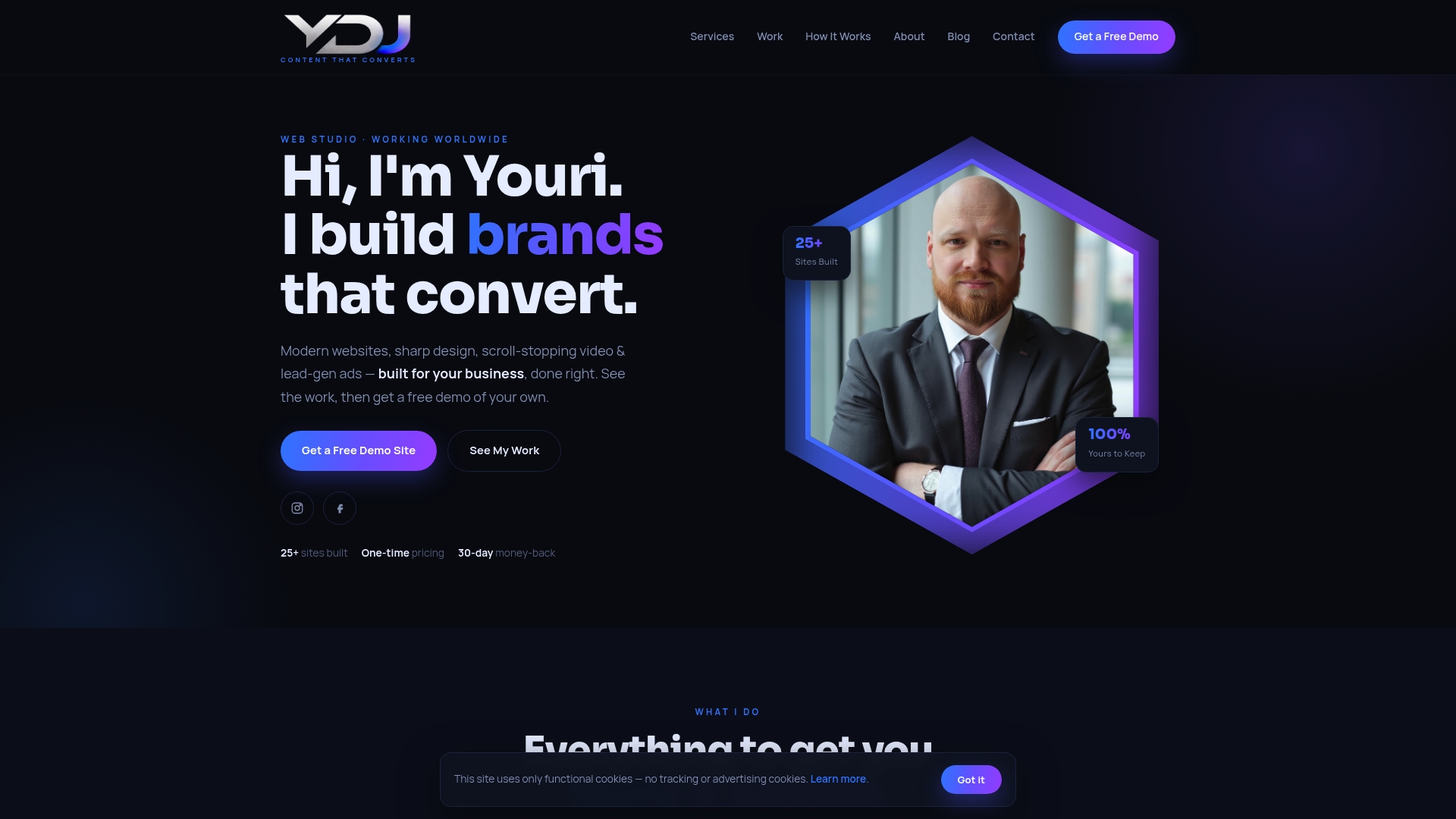
Ydjmedia offers a no-risk free demo so you can see your personal brand website live before spending a dollar. There are no surprise retainers, no agency runaround, and a 30-day money-back guarantee on every project. From professional design to conversion optimization, Ydjmedia handles the technical side so you can focus on your brand. Reach out today and get a site that works as hard as you do.
FAQ
What is a personal brand website strategy?
A personal brand website strategy is a plan that defines your identity, target audience, content approach, and conversion goals before you build or redesign your site. It prevents inconsistent messaging and ensures every page serves a clear purpose.
How many pages does a personal brand website need?
A personal brand website needs at minimum five pages: homepage, about, portfolio or proof, contact, and a lead capture page. A content hub such as a blog adds long-term SEO and authority benefits.
How long does it take to build a personal brand website?
With a content-first approach and no-code tools, a personal brand website can launch in days once your copy is written and ready. The writing and strategy phase typically takes longer than the technical build.
What is Person schema markup and why does it matter?
Person schema markup is structured data you add to your homepage and about page that tells AI search engines who you are and what you specialize in. It directly improves how AI tools recognize and cite your personal brand in search results.
How often should I update my personal brand website?
Publish new content at least once a week and audit your full site every quarter. Stale sites lose search visibility and AI citations, which reduces the organic traffic that drives new leads.