
Showcasing services online is the practice of presenting your offerings through websites, content, and digital channels in a way that compels visitors to become paying clients. The best ways to showcase services online combine clear structure, specific proof, and conversion-focused design. Generic service pages lose clients before a conversation even starts. The strategies below are built for small business owners, freelancers, and service providers who want their online presence to do real selling work.
1. Ways to showcase services online: start with the right website structure
Your website structure is the foundation of every other tactic. Limit navigation to five items or fewer to reduce cognitive load and guide visitors toward a decision. Every extra menu item splits attention and reduces the chance a visitor reaches your contact page.
Each service deserves its own dedicated page. One page per service sharpens your messaging and gives search engines a clear signal about what you offer. Combining multiple services on one page dilutes both.

Your homepage acts as a router, not a brochure. The hero section should state who you help, the result you deliver, and include a single call to action button. Visitors decide within seconds whether to stay or leave.
Pro Tip: Treat your homepage like a lobby with clear signs. If a visitor cannot identify your main service within five seconds, your structure needs work. Check your own site with a fresh pair of eyes or ask someone unfamiliar with your business to describe what you do after a five-second look.
2. Build each service page as a full sales conversation
A service page is not a product listing. It should cover what the service is, who it is for, how the process works, what it costs, and what results clients can expect. Each page should end with a direct call to action so visitors always have a clear next step.
Anticipate objections within the page itself. If clients commonly ask about timelines, include that. If price is a concern, address it directly. Avoiding these questions does not make them disappear. It just means the visitor leaves to find answers elsewhere.
The goal is to make the page feel like a conversation with a knowledgeable advisor. Pair this with conversion-focused design principles to keep the layout clean and the path to contact obvious.
3. Use service cards and visual elements to present offerings clearly
Service cards on your homepage give visitors a fast overview of what you offer. Each card links to the full service page and includes a short headline, a one-sentence outcome statement, and an icon or photo. This format works because it respects the visitor’s time.
Visual elements carry real weight in online service presentation. Authentic service photos of your team, your workspace, or your work in progress build trust faster than stock images. Visitors want to see the real people behind the service.
Video is one of the most effective tools for digital marketing for services. A short explainer or a founder introduction on your homepage can communicate personality and credibility in under 90 seconds. The role of video in service websites is well documented as a conversion driver.
Pro Tip: Add a short FAQ section directly on each service page. Answering three to five common questions reduces friction and keeps visitors on the page longer, which signals quality to search engines.
4. Lead with proof, not pitch
The most effective online service presentation tips center on one principle: proof beats pitch every time. Generic marketing copy creates skepticism. Specific, named client outcomes build trust.
Testimonials need specifics to work. A quote that says “Great service!” does nothing. A quote that says “We booked 12 new clients in six weeks after the redesign” is credible. Testimonials with names, photos, and quantified results consistently outperform generic praise.
Case studies take proof further. A short problem-solution-result narrative, even 150 words long, shows potential clients exactly what working with you looks like. Pair it with a metric and a client name, and you have one of the strongest trust signals available.
- Include client name and photo with every testimonial
- State the specific result and timeframe
- Add case studies with a clear problem-solution-result structure
- Display certifications, awards, or notable client logos with permission
- Place proof elements throughout the site, not just on a dedicated testimonials page
5. Optimize your Google Business Profile for local visibility
For service providers with a geographic focus, local SEO is a direct client acquisition channel. Google Business Profile listings with over 10 reviews and ratings above 4 stars appear significantly more often in local search results. That visibility translates directly into inbound calls and inquiries.
Claim and complete your profile fully. Add photos, list your services, set your service area, and respond to every review. An incomplete profile signals neglect to both Google and potential clients.
Encourage satisfied clients to leave reviews immediately after a successful project. The timing matters. Clients are most motivated to write a review in the 24 hours after a positive outcome.
6. Use SEO and content to attract buyer-ready visitors
SEO targets people who are already searching for what you offer. That intent makes organic search traffic more valuable than most paid channels for long-term client acquisition. The catch is patience. SEO work performed in month one typically yields leads by month four. Most service providers quit before the results arrive.
Focus your SEO on buyer-intent keywords rather than broad informational terms. “Freelance graphic designer for restaurants in Austin” converts far better than “what is graphic design.” Niche specificity is the advantage small businesses have over large generalist platforms.
Blog content supports your service pages but does not replace them. Write posts that answer questions your ideal clients ask before hiring someone like you. Each post builds authority and drives traffic to your core service pages.
7. Choose one or two social media platforms and use them well
Social media rarely converts cold audiences into paying clients directly. Its real value is trust building over time. A potential client who has seen your work 10 times on Instagram is far more likely to book than someone who finds you cold through a search.
Pick one or two platforms where your ideal clients actually spend time. A B2B consultant belongs on LinkedIn. A wedding photographer belongs on Instagram. Spreading thin across five platforms produces weak results on all of them.
Post consistently and show your process, your results, and your personality. Behind-the-scenes content and client success stories outperform polished promotional posts in engagement and trust building.
8. Use email marketing to nurture longer sales cycles
Email marketing is the most underused channel for service providers with longer sales cycles. A potential client who downloads a free resource or signs up for your newsletter is not ready to buy today. They may be ready in three months.
A simple email sequence of four to six messages, sent over six to eight weeks, keeps you visible and builds credibility. Each email should deliver one useful idea or insight. The goal is to be the first person they think of when they are ready to hire.
Email also works for past clients. A quarterly check-in or a note about a new service offering can reactivate relationships that would otherwise go cold.
9. Fix the mistakes that silently kill conversions
The most common mistakes in online service presentation are not dramatic. They are quiet. Overloaded navigation, vague copy, missing prices, and no clear call to action each cost you clients without any obvious warning sign.
Vague copy is the biggest offender. Phrases like “we deliver results” or “quality you can trust” say nothing. Replace them with specific outcomes: “We build websites that load in under two seconds and generate inbound leads within 90 days.” Specificity is credibility.
Missing calls to action create dead ends. Every page should end with a visible next step, whether that is a contact form, a booking link, or a phone number. Visitors who reach the bottom of a page without a prompt will leave. Review your homepage for common mistakes that quietly push clients away.
Pro Tip: Never hide your pricing entirely. You do not need to publish exact rates, but a starting price or a price range sets expectations and filters out poor-fit clients before they waste your time.
Key takeaways
The most effective ways to showcase services online combine clear structure, specific proof, and consistent calls to action across every page and channel.
| Point | Details |
|---|---|
| Structure drives conversion | Limit navigation to five items and give each service its own dedicated page. |
| Proof outperforms pitch | Use named testimonials with specific results and case studies with measurable outcomes. |
| Local SEO delivers fast wins | A complete Google Business Profile with 10+ reviews increases local search visibility significantly. |
| SEO requires patience | Expect a four-month lag before organic content generates consistent leads. |
| Every page needs a CTA | End every service page with a visible, specific call to action to prevent visitor drop-off. |
What I’ve learned from building service websites that actually convert
I’ve reviewed and built dozens of service websites across industries ranging from home renovation to consulting to creative services. The pattern is always the same. The sites that convert well are not the prettiest ones. They are the clearest ones.
The single biggest shift I see is when a service provider stops writing for themselves and starts writing for the client’s fear. Clients are not buying your service. They are buying the relief of their problem being solved. When your page speaks to that directly, with proof that it has happened before, the conversion rate changes fast.
Founder visibility matters more than most people expect. A real photo, a short bio, and a genuine explanation of why you do this work tip a fence-sitter into a client. People hire people, not logos.
One more thing: do not abandon SEO after two months because you see no results. The four-month lag is real and predictable. The service providers who stay consistent are the ones who own their niche in search results a year later.
— Youri
How Ydjmedia helps you present your services professionally
Getting your service presentation right takes more than good intentions. It takes the right structure, design, and messaging working together from day one.
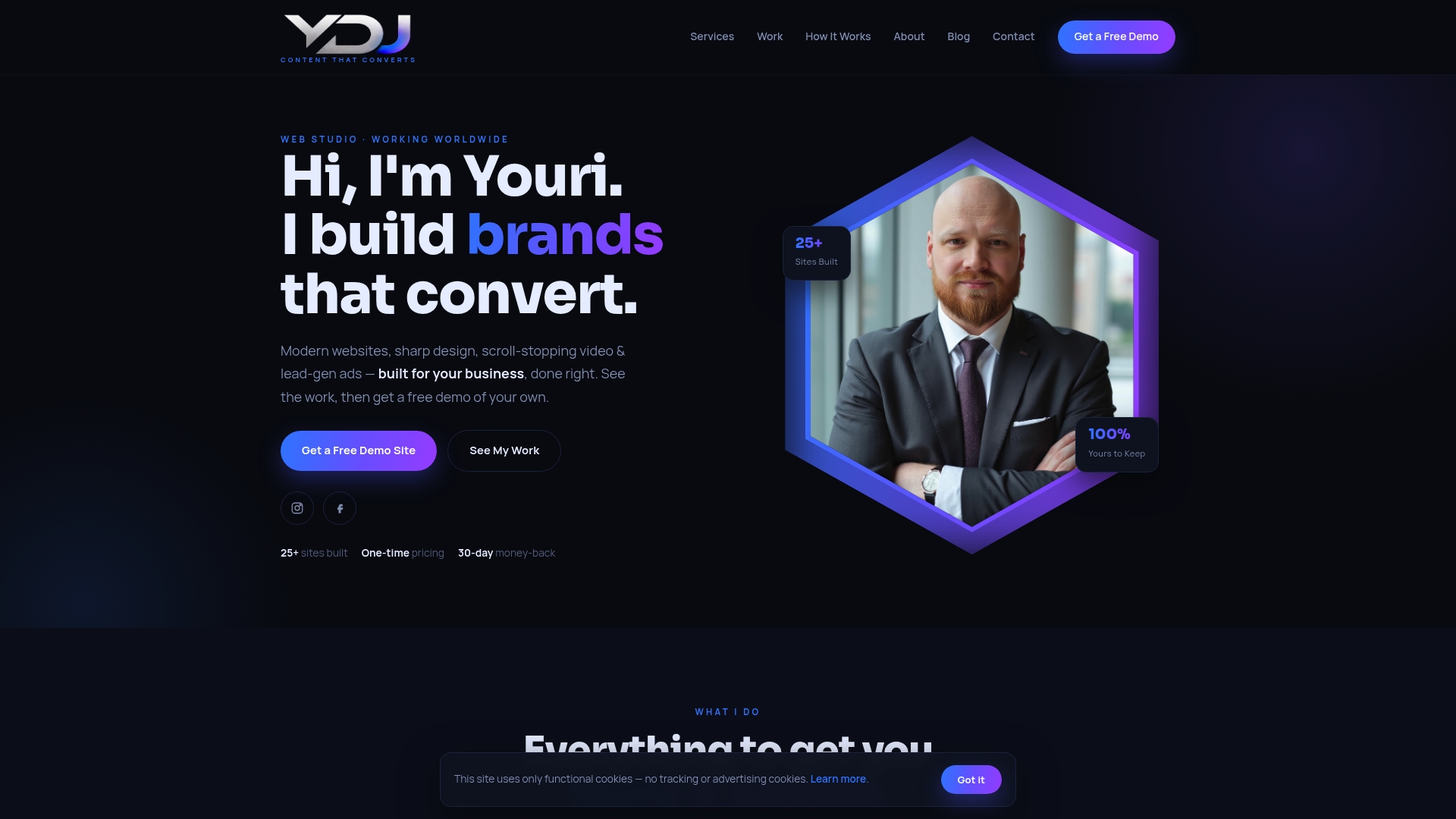
Ydjmedia builds modern, mobile-first websites designed to convert visitors into clients. Every site includes clear service pages, conversion-focused layouts, and professional video content that makes your offering impossible to ignore. The process starts with a free demo site so you can see exactly what your website will look like before spending a dollar. There are no retainers, no agency runaround, and a 30-day money-back guarantee. If you are ready to present your services with the clarity and credibility they deserve, Ydjmedia is built for that.
FAQ
What makes a service page convert well?
A high-converting service page covers what the service is, who it is for, the process, pricing signals, and specific proof of results. It ends with a clear call to action so visitors always know the next step.
How many services should I list on my homepage?
Show your core services as cards or tiles that link to individual pages. Limit navigation to five items and avoid combining multiple services on a single page, which dilutes both messaging and SEO.
How long does SEO take for a service business?
SEO typically takes about four months before generating consistent leads. Work done in the first month compounds over time, so consistency matters more than speed.
What type of social proof works best for service providers?
Testimonials with client names, photos, and specific results outperform generic quotes. Case studies with a clear problem-solution-result structure and a measurable outcome are the strongest trust signals available.
Do I need to show pricing on my service pages?
You do not need to publish exact rates, but showing a starting price or price range sets expectations, filters out poor-fit clients, and builds trust with serious buyers.