
Website conversion is defined as the moment a visitor completes a desired action on your site, whether that’s making a purchase, submitting a form, or booking a call. Average conversion rates sit around 2.35%, while the top 10% of sites convert at above 11%. That gap is not luck. It comes down to deliberate decisions about copy, design, trust, and user experience. This guide breaks down exactly how website conversion works, what moves the needle, and what you can do right now to close that gap.
How website conversion works: metrics and types
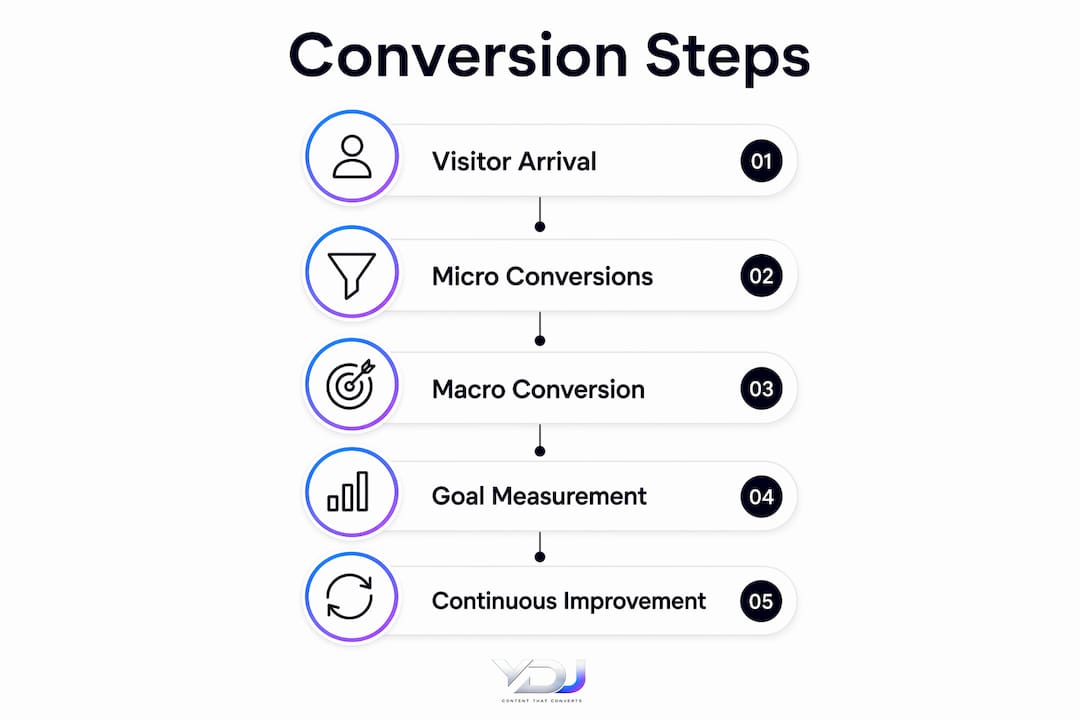
Website conversion rate optimization, commonly called CRO, is the practice of increasing the percentage of visitors who complete a target action. The formula is simple: divide the number of conversions by total visitors, then multiply by 100. If 50 out of 2,000 visitors buy something, your conversion rate is 2.5%.
Not all conversions are equal. The industry separates them into two categories:
- Macro conversions: The primary revenue actions. These include completed purchases, signed contracts, and booked appointments. Macro conversions drive revenue, so they get priority in any optimization effort.
- Micro conversions: Smaller intent signals that lead toward the macro goal. Examples include newsletter signups, video plays, product page views, and add-to-cart actions.
Micro conversions matter because they reveal where visitors drop off in your funnel. If 500 people add a product to their cart but only 50 complete checkout, the problem lives in the checkout flow, not the product page. Tracking both types gives you a complete picture of visitor behavior.
Conversion rates vary widely by industry and traffic source. Organic search visitors typically convert better than social media traffic because their intent is higher. Paid traffic can perform well when the ad message matches the landing page exactly. Understanding which traffic source drives your best converters is the first step in any serious CRO effort.

Pro Tip: Set up goal tracking in Google Analytics 4 before you run any tests. You cannot improve what you cannot measure.
What factors affect how your site converts?
Several forces shape whether a visitor converts or leaves. Most business owners focus on design, but copy and trust signals carry far more weight.
Positioning clarity
Visitors decide within seconds whether your site is relevant to them. Your headline must answer three questions immediately: what you do, who you do it for, and why you are the right choice. Vague headlines like “We help businesses grow” fail this test. Specific ones like “Mobile-first websites for local service businesses, built in 7 days” pass it.
Conversion architecture
The layout of your page guides or blocks action. Key elements include:
- Calls to action (CTAs): Place them above the fold, after key benefit statements, and at the bottom of the page. One clear primary CTA per page outperforms a page cluttered with competing options.
- Form length: Shorter forms convert better. Reducing form fields from the industry average of 23.48 down to 12–14 fields lifts checkout conversion by 35.26% on average. Every field you remove reduces friction.
- Information flow: Lead with the benefit, follow with proof, then ask for the action. Reversing this order kills conversions.
Copy quality
Specific, benefit-driven copy outperforms generic copy every time. Use the exact words your customers use to describe their problem. If your customers say “I need a website that doesn’t look cheap,” your headline should reflect that language, not a polished agency version of it.
Trust signals
Testimonials, security badges, guarantees, and real photos of your team all reduce the perceived risk of taking action. Place trust signals close to your CTA, not buried at the bottom of the page. A money-back guarantee placed next to a “Buy Now” button removes the last objection a fence-sitter has.
Technical performance
A 0.1-second improvement in page load time produces an 8.4% lift in retail conversion. Sites that meet Google Core Web Vitals standards load under 2.5 seconds and deliver a measurably better user experience. Slow pages bleed conversions silently.
Pro Tip: Run your site through Google PageSpeed Insights monthly. Fix the top two issues it flags before touching anything else.
Practical website conversion strategies that actually work
Knowing the factors is one thing. Applying them in the right order is another. These steps give you the fastest path to better results.
-
Fix your headline first. Headline rewrites produce 20–50% conversion lifts. Button color changes produce 2–10%. Start where the leverage is highest.
-
Build dedicated landing pages. Dedicated landing pages convert at 23%+ on average versus 2–3% for typical home pages. Remove the navigation menu. Match the headline to the ad or email that sent the visitor there. This single practice, called message match, is often the cheapest fix available.
-
Reduce form friction. Cut every field that is not strictly necessary. Use inline validation so visitors see errors as they type, not after they submit. Offer guest checkout on e-commerce sites. Each of these changes removes a reason to abandon.
-
Optimize for mobile. Over 60% of web traffic comes from mobile devices, yet mobile conversion rates lag behind desktop. Tap targets should measure at least 44x44 pixels and body text should sit at 16px or larger. Small tap targets and tiny fonts are silent conversion killers on mobile. Ydjmedia builds every site mobile-first for exactly this reason.
-
Place trust signals near your CTA. A testimonial or guarantee directly above or below your primary button reduces hesitation at the exact moment it matters most.
-
Run A/B tests with statistical significance. Test one variable at a time. Do not call a winner until your results reach statistical significance, typically at 95% confidence. Ending tests early produces false winners and wastes future effort.
The table below shows which changes typically deliver the highest conversion impact relative to effort:
| Change | Effort | Typical Conversion Impact |
|---|---|---|
| Headline rewrite | Low | 20–50% lift |
| Form field reduction | Low | Up to 35% lift |
| Dedicated landing page | Medium | 10x vs. home page |
| Page speed improvement | Medium | 8.4% per 0.1s gained |
| Mobile tap target fixes | Low | Significant on mobile |
| Button color change | Very low | 2–10% lift |
How to measure and continually improve conversions
Measuring conversion performance requires more than checking your overall rate once a month. You need a system.
Start with these core metrics:
- Conversion rate by traffic source: Organic, paid, social, and direct traffic convert at different rates. Knowing which source performs best tells you where to invest.
- Funnel drop-off points: Where do visitors leave your checkout or signup flow? A sharp drop between the cart and payment page points to a specific problem worth fixing.
- Bounce rate by page: A high bounce rate on a landing page usually signals a message match failure between the ad and the page.
Heatmaps and session recordings show you what analytics cannot. They reveal where visitors click, how far they scroll, and where they get confused. Tools like Microsoft Clarity offer free heatmap and session recording data. Pair this with your analytics to form a complete picture.
When you have enough data to test, use the EPIC framework to prioritize your experiments. EPIC stands for Experiment value, Priority, Impact, and Cost. It stops you from testing low-value ideas while high-impact opportunities sit untouched.
Expect most tests to produce no significant result. Only about 12% of A/B tests produce a statistically significant winner. That number is not discouraging. It means CRO is a continuous learning process, not a one-time project. Each test teaches you something about your visitors, even when it does not produce a winner.
Server-side tracking via APIs gives you more accurate conversion data than browser-only JavaScript tracking. Ad blockers and script failures cause browser tracking to undercount conversions, sometimes significantly. If your data feels low, your tracking setup may be the problem.
Key Takeaways
Website conversion improves fastest when you fix copy and message match first, then reduce friction, then test systematically with accurate data.
| Point | Details |
|---|---|
| Define your conversion goal | Identify macro conversions first; they drive revenue and set your optimization priority. |
| Fix headlines before design | Headline rewrites deliver 20–50% lifts; button color changes deliver only 2–10%. |
| Reduce form friction | Cutting fields to 12–14 from the industry average lifts checkout conversion by 35%. |
| Match ads to landing pages | Dedicated landing pages convert at 23%+ versus 2–3% for typical home pages. |
| Treat CRO as a cycle | Only 12% of A/B tests win; continuous testing builds compounding knowledge over time. |
What I’ve learned after building conversion-focused sites
I’ve worked on enough websites to know that most business owners chase the wrong fixes first. They spend weeks choosing a new color palette or debating font choices while their headline still fails to explain what they actually do. Design matters, but copy is the engine.
The single highest-leverage audit you can do today costs nothing. Read your homepage headline out loud and ask: would a stranger understand what I do and why it matters in under five seconds? If the answer is no, that is your first test. Rewrite the headline before you touch anything else.
I also see business owners obsess over traffic volume while ignoring conversion quality. Doubling your traffic with a 1% conversion rate gives you the same result as fixing your site to convert at 2% with the same traffic you already have. The second path costs less and compounds faster.
One more thing most guides skip: your tracking setup is probably lying to you. Browser-based tracking misses a meaningful share of conversions due to ad blockers and script errors. Before you make any decisions based on your data, verify that your conversion tracking accuracy is solid. Bad data leads to bad tests and wasted effort.
The business owners I see make the most progress treat CRO as a permanent program, not a one-time project. They test, learn, and apply. They do not chase a single big win. They build a system that gets a little better every month. That is what separates the top 10% of converting sites from everyone else.
— Youri
Ydjmedia builds sites designed to convert from day one
Getting your website to convert is not just about running tests. It starts with the foundation: a site built with the right structure, copy, and mobile experience from the beginning.
Ydjmedia specializes in mobile-first websites built specifically to turn visitors into customers. Every site includes clear CTAs, trust signals, and fast load times baked in from the start. You can see your site live before paying a cent with Ydjmedia’s free demo offer. There are no retainers, no agency runaround, and a 30-day money-back guarantee. If you want a site that works as hard as you do, see what’s possible for your business today.
FAQ
What does website conversion mean?
Website conversion means a visitor completes a desired action on your site, such as making a purchase, booking a call, or submitting a form. The conversion rate is the percentage of visitors who complete that action.
What is a good website conversion rate?
The average conversion rate across industries is around 2.35%, while top-performing sites exceed 11%. A rate above 5% is considered strong for most business types.
What is the fastest way to improve conversions?
Rewriting your headline and matching your landing page copy to your ad or email message produces the fastest results. These copy-driven changes deliver 20–50% lifts, far more than design tweaks.
How do I measure my website conversion rate?
Divide the number of completed goal actions by total visitors, then multiply by 100. Set up goal tracking in Google Analytics 4 and verify accuracy with server-side tracking to avoid undercounting from ad blockers.
What is the EPIC framework in CRO?
The EPIC framework stands for Experiment value, Priority, Impact, and Cost. It helps marketers rank which tests to run first so they focus effort on the highest-return opportunities.