
Local service website customer engagement is defined as the set of website design, content, and communication strategies that turn casual visitors into paying customers. Most local service sites convert only 2–3% of visitors to leads, while top performers reach 8–15%. That gap is not luck. It comes down to clarity, trust, and how fast you respond. 58% of leads at local service companies go unanswered, costing the average business roughly $6,800 per month in lost revenue. Your website is the first place to fix that.
What website features most effectively boost local service customer engagement?
The single most impactful feature on any local service website is a visible, tappable phone number in a sticky header. A phone number in a sticky mobile header increases call conversion rates by 25–40%. That one change alone can tip a fence-sitter into a customer before they scroll past your hero section.
Beyond the phone number, these features consistently drive stronger engagement on local service websites:
- Prominent headline with service and location. “Plumber in Austin, TX” beats “Welcome to Our Website” every time. Visitors need to confirm within three seconds that you serve their area and do the work they need.
- Real team and project photos. Buyer skepticism is the top reason local website conversions fail. Authentic images of your crew and completed jobs reduce that skepticism faster than any copywriting trick.
- Google reviews above the fold. Displaying genuine reviews near the top of your homepage removes doubt before it forms. Stock photos and generic testimonials do the opposite.
- Simplified contact forms. Every extra field you add to a contact form drops completion rates by roughly 11%. Ask for name, phone, and service type. Nothing else.
- Clear, single call to action per page. One CTA per page outperforms three competing buttons. Confusion kills clicks.
Pro Tip: Place your phone number, service area, and a single CTA button in the first visible section of every page. Visitors should never have to scroll to find out how to reach you.
The goal of every feature listed above is to reduce friction. The faster a visitor can confirm you are the right fit and contact you, the higher your conversion rate climbs. Think of your website as a well-trained front desk employee who never takes a day off.

How do you craft website content that engages and converts local customers?
Generic service pages lose customers. A page titled “Services” with a bulleted list of offerings gives visitors no reason to choose you over anyone else. Content that converts is specific, honest, and built around what your customer is already worried about.
Here is a five-step content framework that works for local service providers:
- Create a dedicated page for each service. A roofing company should have separate pages for roof repair, roof replacement, and gutter cleaning. Each page targets a specific search and speaks to a specific problem. Bundling everything onto one page dilutes both SEO and conversion.
- Lead with the customer’s pain point. “Tired of a leaky roof ruining your weekends?” outperforms “We offer quality roofing services.” The first sentence should mirror what the customer typed into Google.
- Show pricing ranges. Pricing transparency can increase conversion rates by 20% or more by reducing purchase hesitation. You do not need to publish exact quotes. A range like “$150–$400 for most standard repairs” tells the customer enough to stay on the page.
- Embed service-specific reviews. A review about your HVAC tune-up service belongs on your HVAC page, not buried in a generic testimonials section. Matching the review to the service context makes it far more persuasive.
- End every page with one clear CTA. “Get a Free Quote” or “Call Now” works. “Contact Us for More Information About Our Services” does not. Short, direct, and benefit-focused CTAs get clicked.
Pro Tip: Read your service page headlines out loud. If they sound like a brochure, rewrite them to sound like a conversation. Your customer is a person with a specific problem, not a demographic.
Content strategy for local businesses is not about writing more. It is about writing the right thing in the right place. A well-written 300-word service page with a clear CTA outperforms a 1,500-word generic essay every time. Check out conversion tips for entrepreneurs for more on structuring pages that actually close.
Why does mobile-first design matter for service website engagement?
Over 70% of local service website traffic comes from mobile devices. That means the majority of your potential customers are browsing on a phone, probably with one thumb, while standing in their kitchen or sitting in their car. If your site is hard to use on a phone, most of them leave.
Mobile-first design for local service websites requires these specific practices:
- Minimum 44x44 pixel tap targets. Buttons smaller than that are nearly impossible to tap accurately on a touchscreen. The Web Content Accessibility Guidelines (WCAG) set this as the minimum for accessible design.
- Fast page load times. Slow pages drive visitors away before they read a single word. Compress images, minimize scripts, and use a reliable host.
- Sticky mobile header with click-to-call. The phone number should follow the user as they scroll. A click-to-call link means one tap connects them to you directly.
- Short, single-column forms. Multi-column layouts break on small screens. Keep forms vertical and limit fields to three or fewer inputs.
- Large, thumb-friendly CTA buttons. Place primary buttons in the lower half of the screen where thumbs naturally rest. Avoid placing critical actions in the top corners.
The math is straightforward. If 70% of your traffic is mobile and your mobile experience is poor, you are losing the majority of your potential leads before they even read your headline. Mobile-first is not a design preference. It is a business requirement in 2026.
How do engagement tools and fast response systems work together?
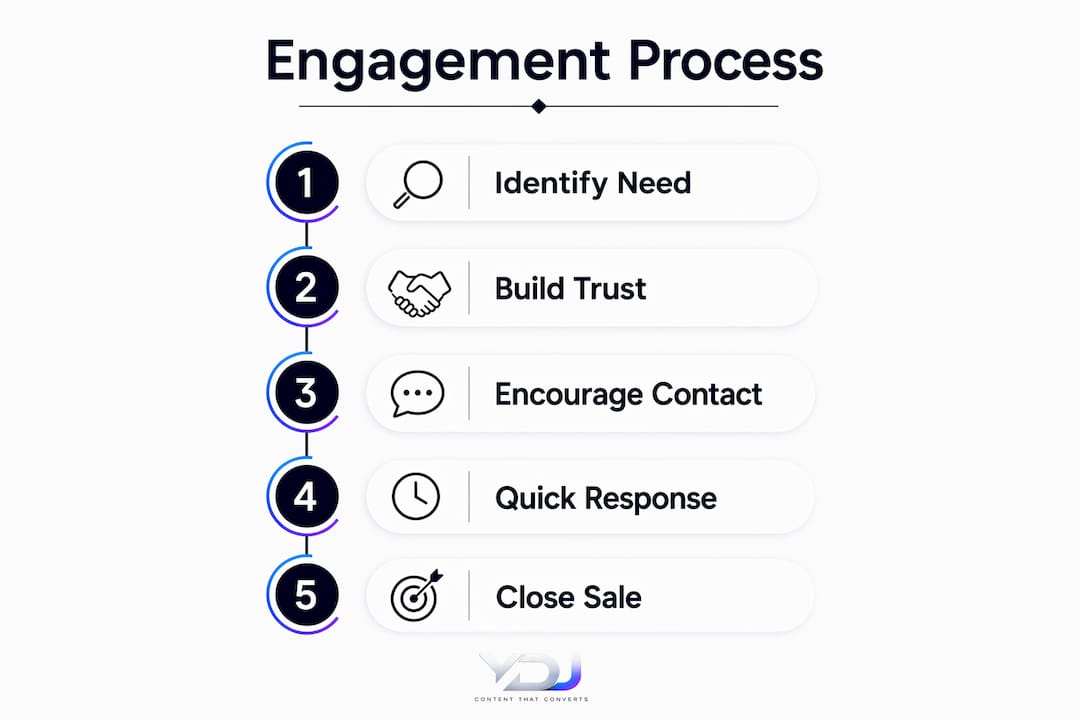
82% of homeowners hire the first company that responds to their inquiry. That single statistic reframes how you should think about your website. Getting a visitor to fill out a form is only half the job. What happens in the next five minutes determines whether you win the job.
The most effective engagement setups combine automated alerts with human follow-up. When a form is submitted, an automated text or email should notify you or your team within seconds. A chatbot can handle the initial greeting and collect basic details, but it must escalate to a real person quickly. Customers asking about pricing or availability do not want a bot loop.
| Engagement tool | Best use case | Key limitation |
|---|---|---|
| Automated form alerts | Instant team notification on lead submission | Requires fast human follow-up to be effective |
| Live chat with escalation | Answering quick questions and qualifying leads | Needs staffing during business hours |
| Click-to-call button | Direct phone connection for ready-to-buy visitors | Only works when someone is available to answer |
| Review request automation | Post-job Google review collection | Timing matters; send within 24 hours of job completion |
Omnichannel consistency matters too. A customer who sees one message on your website and a different tone in your follow-up email loses confidence. Your website, automated messages, and phone calls should all sound like the same business. Ydjmedia builds this kind of consistency into every site it delivers, from the hero section copy to the contact confirmation message. For more on how video content fits into this picture, see video content for service businesses.
My honest take on what actually moves the needle
I have worked with enough local service providers to know the most common mistake: spending money on a beautiful website that nobody can use on a phone. Owners get excited about fonts and color palettes. Customers care about whether they can find your phone number in under five seconds.
The second mistake is treating the website as a finished product. Your site is a working tool. If a page gets traffic but no calls, something on that page is broken. Change the headline. Shorten the form. Move the CTA button. Test it for two weeks and look at the numbers. Most owners never do this, which is why their conversion rate stays stuck at 2%.
The most underrated tactic I have seen work consistently is authentic service photos. Not stock images. Real photos of your team, your truck, your finished work. I have seen a single before-and-after photo section lift contact form submissions noticeably on a landscaping site. Customers want proof you are real and that you do good work.
Finally, speed of response is the one variable that beats almost everything else. You can have the best-designed site in your market and still lose the job to a competitor who called back in three minutes. Build your response system before you worry about your logo.
— Youri
How Ydjmedia helps local service providers get more from their websites
If you recognize any of the gaps described in this article, you are not alone. Most local service websites were built to look good, not to convert.
Ydjmedia builds mobile-first websites designed specifically for local service providers who need real leads, not just a digital business card. Every site includes a free demo so you can see exactly what your site will look like before spending a dollar. There are no retainers, no agency runaround, and a 30-day money-back guarantee. If you want a site that answers the phone for you at 2 AM, Ydjmedia is worth a look.
Key takeaways
Strong local service website engagement requires fast response systems, mobile-first design, trust-building content, and a single clear CTA on every page.
| Point | Details |
|---|---|
| Speed of response wins jobs | 82% of customers hire the first company that responds, so automate your lead alerts immediately. |
| Mobile design is non-negotiable | Over 70% of traffic is mobile; use 44x44px buttons and sticky click-to-call headers. |
| Pricing transparency lifts conversions | Showing cost ranges reduces hesitation and can increase conversions by 20% or more. |
| Fewer form fields mean more submissions | Each extra field drops completion rates by roughly 11%; keep forms to three fields maximum. |
| Real photos build trust faster than copy | Authentic team and project images reduce buyer skepticism and increase time on page. |
FAQ
What is local service website customer engagement?
Local service website customer engagement is the combination of design, content, and communication features that prompt visitors to contact or hire a local business. It includes elements like click-to-call buttons, trust signals, and fast response systems.
How many form fields should a local service contact form have?
Three fields is the target: name, phone number, and service type. Each additional field reduces form completion rates by roughly 11%.
Why does mobile design affect engagement on service websites?
Over 70% of local service website traffic comes from mobile devices. A site that is hard to use on a phone loses the majority of its potential leads before they reach the contact form.
What is the fastest way to improve local website conversions?
Add a sticky header with a tap-to-call phone number. This single change can increase call conversions by 25–40% with no other modifications to the site.
How does pricing transparency affect customer behavior?
Showing price ranges rather than hiding costs reduces purchase hesitation and can lift conversion rates by 20% or more, because customers feel informed rather than uncertain.