
Why storytelling on websites drives real engagement
Storytelling on websites is the strategic use of narrative elements to emotionally engage visitors and motivate them to take action. It is not about writing long paragraphs or adding a “our story” page nobody reads. It is about giving your content a character, a sequence of events, and a setting that pulls visitors in and makes your message stick.
The research backs this up hard. Emotional storytelling generates 1.8 times the user interaction compared to traditional content. That gap is not a rounding error. It is the difference between a visitor who bounces in 10 seconds and one who reads, clicks, and buys.
Here is what effective website storytelling does for you:
- Builds an emotional connection between your brand and your visitors
- Makes your message more memorable than a list of features ever could
- Guides visitors through a logical, emotionally satisfying path toward your CTA
- Increases time on site, repeat visits, and social sharing
- Converts fence-sitters into paying customers by making them feel understood
What makes a website story actually work?
Three core components drive narrative effectiveness: character, sequence of events, and setting. Research analyzing over 85,000 Facebook posts found that all three elements together create stronger engagement than any single element alone. That synergy is what Narrative Transportation Theory (NTT) describes: when a story pulls readers fully into its world, they lower their defenses and become genuinely open to persuasion.
Character is your hero. On a website, that is usually your customer, not your brand. When visitors see someone like themselves facing a familiar problem, they lean in.
Sequence of events gives the story momentum. A before-and-after arc, a problem-solution structure, or a three-act format all work because they create forward motion. Visitors want to know what happens next.

Setting grounds the story in reality. Including specific dates or locations in your narrative correlates with higher engagement because it signals authenticity. “A small bakery in Austin, Texas” lands differently than “a local business.”
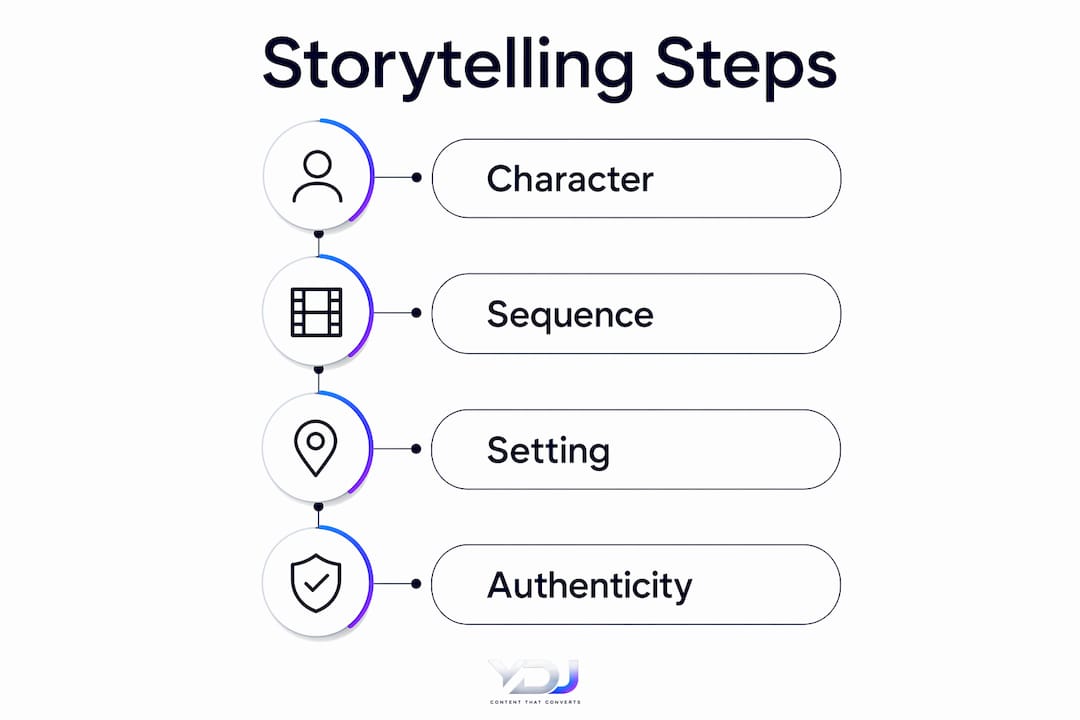
One more thing: authenticity matters more than polish. A meta-analysis of 64 studies confirmed that user-generated stories increase narrative transportation and persuasion beyond what professional content alone achieves. Mixing real customer voices with your brand messaging is not just nice to have. It is a proven engagement multiplier.
How storytelling drives conversions, not just clicks
Storytelling does not just make your site more enjoyable. It changes visitor behavior in measurable ways.
Research highlight: Emotional storytelling formats nearly double engagement rates compared to standard institutional content, with an engagement rate odds ratio that indicates roughly twice the engagement.
The mechanism works like this: a well-told story builds relatability first, then trust, and trust drives engagement. A study of 273 Instagram users confirmed this sequential mediation path, showing that storytelling content leads to relatability, which builds trust, which produces higher audience engagement. The same chain applies on your website.
Benefits you can expect when you get the narrative right:
- Longer average session durations as visitors follow the story arc
- Higher return visit rates because people remember how your content made them feel
- More shares and word-of-mouth referrals driven by emotional resonance
- Stronger conversion rates because persuasive narrative content is consistently rated as more helpful and credible
Watch out for these common pitfalls, though. Over-scripted stories that sound like a press release kill trust fast. Ignoring UX while chasing narrative flair is another trap: if your story is buried under slow load times or confusing navigation, nobody reads it. The best storytelling and the best user experience design work together, not against each other.
Practical strategies for adding storytelling to your website
You do not need to rebuild your site from scratch. You need a framework and a few deliberate choices.
Choose a storytelling framework that fits your site:
- Hero’s Journey: Your customer is the hero. Your product or service is the guide that helps them overcome a challenge. This works well on homepages and landing pages.
- Three-Act Structure: Problem, turning point, resolution. Clean and effective for About pages and case study sections.
- Before and After: Show the world your customer lived in before finding you, then contrast it with the result. Works especially well with visuals and video.
Integrate narrative with your UX and design:
- Place your story arc in the scroll flow so visitors encounter it naturally as they move down the page
- Use your hero section to introduce the character (your customer) and the conflict (their problem)
- Let visuals carry part of the story. Motion design, in particular, increases conversion rates when paired with narrative-driven content
Bring in real customer voices:
- Add short testimonials that follow a mini story arc: situation, struggle, result
- Feature case studies with named details and specific outcomes
- Encourage reviews that describe the experience, not just the rating
Measure what is working:
- Track scroll depth and time on page to see where visitors drop off in your story
- Use heatmaps (tools like Hotjar or Microsoft Clarity) to identify which narrative sections get the most attention
- A/B test your hero section copy with and without a character-driven opening to see which converts better
Pro Tip: Add a 15–30 second autoplay video (muted, with captions) to your homepage hero section that shows a real person experiencing the problem you solve. Video storytelling activates emotional engagement faster than text alone, and it gives visitors an immediate reason to keep scrolling.
Avoiding common homepage mistakes is just as important as adding good narrative. If your above-the-fold content leads with your company name instead of your customer’s problem, you have already lost the story.
How Ydjmedia helps you build a site that tells the right story
Ydjmedia builds modern, mobile-first websites designed to convert, and narrative-driven design is central to that work. Every site starts with the question: what story does this visitor need to hear to take the next step?
Here is what working with Ydjmedia looks like in practice:
- Narrative-first design: Every page is structured around a clear story arc, from the hero section through the CTA, so visitors feel guided rather than sold to
- Motion design integration: Subtle animations and scroll-triggered effects reinforce the story beats and keep visitors engaged longer
- Mobile-first execution: Your story reaches visitors wherever they are, on any device, without losing impact
- Free demo site: You see your actual website live before spending a dollar. No guesswork, no risk
- 30-day money-back guarantee: If the site does not meet your expectations, you are covered. That is a trust signal built right into the business model
- One-time pricing: No retainers, no agency runaround, no surprise invoices
If you want to showcase your services in a way that actually connects with visitors, the story your website tells is the starting point. Ydjmedia handles the design, the narrative structure, and the conversion strategy so you can focus on running your business.
Ready to see what your site could look like? Get your free demo and find out.
Key Takeaways
Storytelling on websites works because it builds the emotional connection that turns casual visitors into committed customers.
| Point | Details |
|---|---|
| Emotional storytelling multiplies interaction | Emotional narrative content generates 1.8 times the user interaction of standard content. |
| Three elements beat one | Character, sequence, and setting together drive stronger engagement than any single narrative element alone. |
| Trust is the conversion bridge | Storytelling builds relatability, which builds trust, which directly increases audience engagement and conversions. |
| User voices amplify impact | Mixing real customer stories with brand content increases narrative transportation and persuasion beyond professional content alone. |
| Measure and refine | Use scroll depth, heatmaps, and A/B testing to identify which story elements drive the most engagement on your site. |