
The quickest way to make your site attractive to investors is to combine a customer-focused homepage with eight investor-facing credibility signals. Here’s what those signals are, in priority order:
- Clear above-the-fold value proposition — who you serve, what you do, and why it matters
- Named founders and team bios with LinkedIn links and verifiable credentials
- Surfaced traction — revenue, users, waitlist size, or press mentions visible on the homepage
- Downloadable investor pack or a dedicated investor contact line
- Professional, mobile-first design with consistent branding
- Fast performance and HTTPS — no broken links, no slow loads
- Trust signals — press logos, client names, awards, case studies
- Roadmap and risk disclosure — where you’re going and what could go wrong
Firms like Metabrand, MBC Strategic, and Ydjmedia all point to the same truth: investors visit your site before they agree to a meeting. Your site either confirms the pitch or kills it.
Pro Tip: Hand this list to your designer today. The single highest-impact move: add an investor contact line, move traction metrics above the fold, and publish a downloadable investor pack.
Table of Contents
- Why investors land on your site and what they’re trying to verify
- The website elements that attract investors: what to include and where
- How to present your metrics, decks, and documents securely
- Design and UX features that lower investor friction
- How long does it take and what does it cost?
- How Ydjmedia helps you get an investor-ready site with no risk
- Legal disclosures and privacy basics your site needs
- How to present risk factors without scaring investors away
- FAQs addressing common investor concerns
- How to keep investors updated with press and financial news
- Key Takeaways
- What actually matters on an investor-ready site (and what most owners get wrong)
- See your investor-ready site live before you pay a cent
- Sources and further reading
Why investors land on your site and what they’re trying to verify
Investors don’t browse your website the way customers do. They’re running a quick verification check. They want to know three things: Who are the founders? Is anything actually working? Can this team execute?
A site that answers those three questions clearly and fast moves an investor from skeptical to curious. One that buries the team on a hard-to-find About page, or hides revenue behind a login wall, raises a red flag. MBC Strategic puts it plainly: the primary goal of an investor-focused site is to build trust and enable inquiry before a formal meeting, and that requires a stable, data-driven presentation.

The good news? Every one of these investor signals also helps convert customers. Clarity, credibility, and speed are universal.
The website elements that attract investors: what to include and where
Each element below maps to a specific investor question. Place them where noted, and use the microcopy samples as starting points.
- Hero value proposition (homepage, above the fold): State the outcome for the customer and who benefits. Example: “We help independent contractors get paid faster — no invoicing software required.” Vague taglines reduce investor interest, according to Waveup.
- Named team bios (About page or homepage): Full name, role, and one credibility line. Example: “Jane Doe, Co-Founder — 10 years in SaaS operations, ex-Salesforce.” Link every bio to LinkedIn. Investors click those links.
- Surfaced traction (homepage): Revenue, waitlist numbers, pilot customers, or press mentions. DEV Community confirms that early traction should be visible on the homepage, not buried in a PDF.
- Business model statement (homepage or dedicated page): One clear sentence on how you make money. This reduces follow-up friction and speeds investor assessment.
- Investor contact line (footer and dedicated investor section): “Investor inquiries: investors@yourbusiness.com” — a separate address signals you take it seriously.
- Downloadable investor pack (investor section): Pitch deck, 12-month KPIs, and a cap table overview. Gate it with a simple form.
- Trust signals (homepage): Press logos, client names, awards, and case studies. An “As Seen In” banner near the hero section works well.
- Roadmap and risk disclosure (investor section or About page): Where you’re headed and what risks you’ve identified. Transparency here builds more trust than hiding problems.
Three CTA templates for investor actions:
- “Download our investor deck” — links to a gated PDF
- “Request data room access” — links to a secure folder
- “Schedule a 20-minute call” — links to a calendar booking tool
Pro Tip: Back every KPI claim with an annotated screenshot of your analytics dashboard, dated and sourced. According to HoM Web Developers, this low-cost step is one of the most overlooked credibility proofs on investor-facing sites.
How to present your metrics, decks, and documents securely
Before you share anything, get your financial reporting in order. Clear financial reporting practices make it far easier to build an investor pack and answer due diligence questions without scrambling.
Investor pack checklist:
- Pitch deck (10–12 slides)
- 12–24 month KPI summary (revenue, growth rate, churn, CAC)
- Customer references or testimonials
- Sample contracts or LOIs (redacted)
- Cap table overview (high-level only)
- Key legal disclosures
Delivery options:
- Password-protected PDF — best for early-stage outreach; low friction, easy to send
- Secure data room (Docsend, Google Drive with restricted access) — better for serious due diligence; tracks who viewed what
- Dedicated investor email — keeps inquiries separate from customer support
Security basics: SSL on every page, time-limited share links, watermarked PDFs, and a log of who accessed what. Never post sensitive personal data or raw cap table details publicly.
Pro Tip: Annotated analytics screenshots with visible date stamps and source labels serve as credible proof without exposing raw data. A screenshot of your Google Analytics showing month-over-month growth is worth more than a claim in a deck.
Design and UX features that lower investor friction
Visual quality acts as an execution proxy. If your site looks unfinished, investors assume your product does too. Website design directly affects perception and brand trust — and for investors, that perception forms in seconds.
Technical checklist:
- Mobile-first, responsive layout
- Page load time under 2.5 seconds
- HTTPS on every page
- No broken links or 404 errors
- Accessible navigation (clear menu, visible contact info)
- Consistent typography and color palette
Real team photos beat stock images every time. A polished product screenshot or a short demo video placed in the hero section communicates execution far better than a paragraph of copy. For video content, keep explainer videos to 60–90 seconds.
Pro Tip: If you use a hero video, keep it silent and auto-play with a play button overlay. A noisy auto-play video is one of the fastest ways to lose a visitor. If the video doesn’t add clarity over a static screenshot, use the screenshot.
How long does it take and what does it cost?
| Task | DIY | Freelancer | Agency | Time |
|---|---|---|---|---|
| Hero copy rewrite | Free | — | — | 1–3 days |
| Team bios + LinkedIn links | Free | — | — | 1–2 days |
| Analytics screenshots + annotations | Free | Free | — | Half a day |
| Investor pack (PDF deck) | Free | — | — | 1–2 weeks |
| Technical polish (HTTPS, speed, mobile) | Free | — | — | 2–5 days |
| Full investor-ready redesign | N/A | — | — | 4–12 weeks |
Priority ranking:
- Must: Clear value prop, named team with LinkedIn, investor contact line
- Should: Traction visible on homepage, downloadable deck, HTTPS
- Nice to have: Interactive charts, gated data room, roadmap timeline
How Ydjmedia helps you get an investor-ready site with no risk
Ydjmedia builds modern, mobile-first sites designed to convert customers and satisfy investor scrutiny. The process is straightforward:
- Discovery call — you walk through your goals, traction, and team
- Live demo site — Ydjmedia builds a working preview, typically within a few days
- Review and revisions — you request changes before committing
- Go-live — one-time pricing, no monthly retainer, 30-day money-back guarantee
Every demo includes a mobile-first homepage, a rewritten hero section, team bios, and an investor contact link. You see the site live before you spend a dollar.
Legal disclosures and privacy basics your site needs
Every investor-ready site needs a few legal basics in place. A privacy policy is non-negotiable if you collect any visitor data, including email addresses from a gated investor pack form. Add a terms of service page and, if you’re in a regulated industry, a relevant compliance disclosure.
For investor-specific content, include a brief disclaimer near your financial metrics: something like “Past performance is not indicative of future results” if you’re showing revenue projections. Keep it short and plain. One line is enough. This is general guidance, not legal advice — confirm the specifics with a qualified attorney for your situation.
How to present risk factors without scaring investors away
Transparency about risk builds more trust than hiding it. Investors expect risk. What they don’t expect is a founder who pretends it doesn’t exist.
A short “Risks and Mitigation” section on your investor page should name your top two or three business risks and explain what you’re doing about each. For example: “Customer concentration risk — our top three clients represent 40% of revenue. We’re actively diversifying with two new verticals launching in Q3.” That kind of honesty signals maturity. It also gives investors less reason to dig for problems on their own.
FAQs addressing common investor concerns
What’s the first thing investors look for on a small business website? The team and the value proposition. Investors want to know who’s behind the business and whether the problem being solved is real and specific.
Do I need a dedicated investor relations page? Not necessarily at the early stage. A clear investor contact line, a downloadable deck, and surfaced traction on the homepage cover most bases.
How much traction do I need before putting metrics on my site? Any honest traction counts: a waitlist, first revenue, a pilot customer, or a press mention. Surface whatever you have rather than waiting for bigger numbers.
Should I post my pitch deck publicly? No. Gate it behind a simple form or share it via a password-protected link. This protects sensitive data and lets you track who’s accessed it.
How to keep investors updated with press and financial news
A dedicated “News” or “Press” section on your site does two things: it shows momentum, and it gives investors a reason to come back. Link to any press coverage, industry mentions, or funding announcements. Keep it current — a news section with entries from two years ago signals stagnation.
For financial updates, a brief quarterly summary (one paragraph, no sensitive raw data) posted to your investor section shows active communication. Pair it with links to any relevant industry news that validates your market. This is especially useful for investors who are still evaluating whether your space is worth backing.
Key Takeaways
A site that converts customers and satisfies investor scrutiny shares the same core elements: a specific value proposition, a named team, visible traction, and a clear path to contact.
| Point | Details |
|---|---|
| Lead with your value prop | State who you serve and what outcome you deliver, above the fold, in one sentence. |
| Surface traction immediately | Revenue, waitlists, or press mentions on the homepage signal momentum before investors dig deeper. |
| Name your team with credentials | Full bios and LinkedIn links let investors verify your team without asking for a meeting first. |
| Gate your investor pack | A downloadable deck behind a simple form protects sensitive data and tracks serious inquiries. |
| Ydjmedia’s no-risk demo | Ydjmedia builds a live, mobile-first demo site before you commit, with one-time pricing and a 30-day money-back guarantee. |
What actually matters on an investor-ready site (and what most owners get wrong)
Most small business owners spend too much time worrying about design and not enough time on clarity. A beautiful site with a vague hero headline will lose an investor in ten seconds. A simple site that names the founders, shows real traction, and has a working investor contact line will keep them reading.
The other mistake I see constantly: over-sharing. Posting your full cap table or unredacted contracts publicly isn’t transparency — it’s a liability. Gate the sensitive stuff. Show the credibility signals openly.
What actually moves investors is the combination of specificity and professionalism. Specific numbers, specific names, specific outcomes. Paired with a site that loads fast, looks clean on mobile, and has no broken links. That combination is rarer than you’d think, and it’s exactly what separates the sites that get follow-up emails from the ones that don’t.
See your investor-ready site live before you pay a cent
Ydjmedia gives small business owners a no-risk path to a professional, investor-ready website. You get a live demo site built to your business before you make any financial commitment. The demo includes a mobile-first homepage, a rewritten hero section, team bios, and an investor contact link — everything on the must-do checklist above.
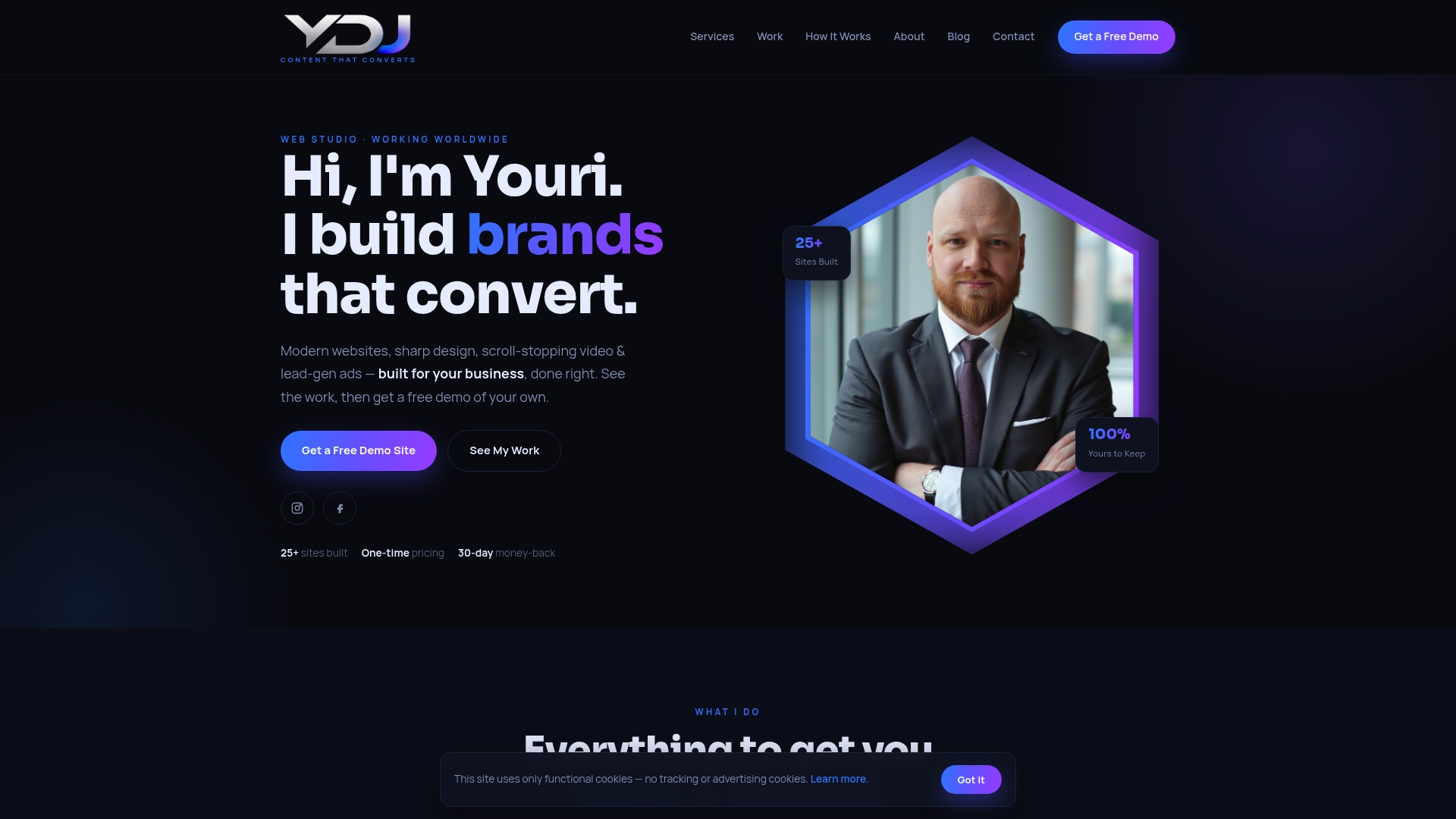
One-time pricing means no surprise monthly fees. The 30-day money-back guarantee means zero risk. If the site doesn’t deliver, you don’t pay. Request your free live demo at Ydjmedia and see exactly what your investor-ready site looks like before you commit.
Sources and further reading
- Metabrand — How to Build an Investor-Ready Startup Website: Primary source for the credibility engine framework and investor verification behavior.
- MBC Strategic — Investment Website Design & Digital Presence: Covers trust-building, compliance-ready design, and data-driven presentation for investor-focused sites.
- HoM Web Developers — 8 Trust Signals That Determine Whether Investors Take the Meeting: Detailed checklist of investor trust signals; primary source for the elements section.
- Waveup — Investor-Friendly Startup Website Design Tips: Hero microcopy and value proposition guidance.
- DEV Community — Investor-Friendly Websites: Traction visibility and business model clarity for early-stage sites.
- True Measure Accounting — Improve Financial Visibility for Your Small Business: Practical steps for cleaning up financials before building an investor pack.
- Boldare — Optimize Your Website to Attract Investors: Six-step framework covering design, SEO, UVP, and team presentation.
- LivePlan — 5 Steps to Optimize Your Website to Attract Investors: Covers professional design, social proof, value proposition, and investor relations pages.