
Visual storytelling is defined as the practice of conveying narratives and emotions primarily through images, video, and visual sequences rather than relying on words alone. The human brain processes visuals 60,000 times faster than text, which makes this approach one of the most powerful communication tools available to content creators and marketers. People remember approximately 80% of what they see compared to only 20% of what they read. That gap explains why brands that master visual narrative consistently outperform those that rely on text-heavy content. If you want your audience to understand, feel, and act, visual storytelling is the method that gets you there.
What does visual storytelling mean at its core?
Visual storytelling is the structured use of images, video, design, and layout to move an audience through a sequence of ideas and emotions. The key word is structured. Random beautiful images are not visual storytelling. A deliberate sequence that takes a viewer from a problem to a resolution, without needing a caption to explain it, is.
The industry term for this practice is “visual narrative,” and it encompasses everything from a three-panel Instagram story to a full brand film. Visual narrative gives every image a job to do. That job is to carry the viewer one step further through the story. When each visual element serves that function, the result is communication that sticks.

Incorporating storytelling with visual elements can improve business conversion rates by approximately 30%. That number reflects something real: when audiences understand your message quickly and feel something about it, they act. Visual storytelling is the mechanism that makes both happen at once.
How does visual storytelling work in the brain?
The psychological foundation of visual storytelling is the picture superiority effect. This principle holds that visuals create stronger memory traces than text alone. Your brain encodes an image through multiple cognitive systems simultaneously, including spatial memory, emotional processing, and pattern recognition. Text activates far fewer of those systems.
“Visual storytelling creates richer, more memorable experiences by engaging multiple cognitive systems at once, unlike linear text approaches. It aligns with fundamental cognitive patterns to not just attract attention but drive meaningful action.”
That multi-system engagement is why a well-crafted photo sequence can communicate a brand’s entire value proposition in seconds. Text requires the reader to construct meaning step by step. Visuals deliver meaning in one cognitive hit.
Emotional connection is the other critical mechanism. When a viewer sees a visual sequence that mirrors their own experience, their brain releases the same neurochemical responses as if they were living that experience. That emotional resonance is what turns passive viewers into buyers, followers, and advocates.
What are the key elements of visual storytelling?
Effective visual narrative is built from specific, learnable components. Understanding each one gives you control over the story your visuals tell.
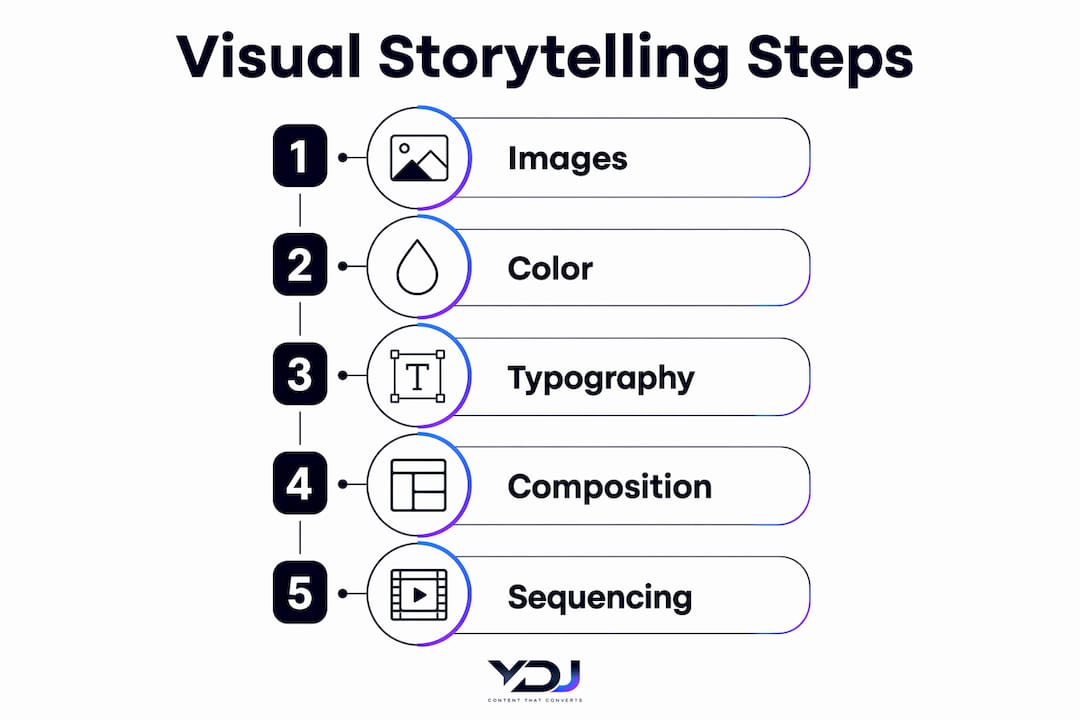
Core visual elements:
- Images and video: The primary carriers of narrative. A single strong image can establish character, conflict, and setting simultaneously.
- Typography: Font choice, size, and placement communicate tone before a word is read. Bold sans-serif fonts signal urgency; elegant serifs signal trust.
- Color schemes: Color carries emotional weight. Warm tones create energy and urgency; cool tones build calm and credibility.
- Layout and composition: Where you place elements on a frame directs the viewer’s eye and controls what they notice first.
- Sequencing and pacing: The order and rhythm of visuals determines how the story unfolds and how the viewer feels at each stage.
Composition, lighting, and camera angles do more than create aesthetics. They set mood, establish depth, and deliver subtle character cues that words cannot easily convey. A low camera angle makes a subject look powerful. Soft, diffused lighting signals safety and warmth. These are storytelling decisions, not style choices.
Infographics are one of the most effective visual storytelling formats for marketers. Infographics are shared three times more than other content types. That sharing behavior happens because infographics compress complex information into a visual sequence that audiences can absorb and pass along instantly.
Pro Tip: Before you finalize any visual asset, ask yourself: if you removed every word, would a stranger still understand the core message? If the answer is no, the visual is decorating, not storytelling.
How does visual storytelling differ from visual design?
This is the most common point of confusion for marketers and content creators. Visual design organizes and beautifies. Visual storytelling communicates a specific narrative arc with a beginning, middle, and end.
| Dimension | Visual design | Visual storytelling |
|---|---|---|
| Primary goal | Organize and attract attention | Move the viewer through a narrative |
| Measure of success | Aesthetic appeal and clarity | Audience understanding without text |
| Core tool | Layout, color, and typography | Sequence, composition, and emotional arc |
| Failure mode | Cluttered or unattractive output | Viewer cannot follow the story |
A beautifully designed homepage that shows product photos with no narrative sequence is visual design. A homepage that opens with a customer’s problem, shows the product solving it, and closes with a satisfied outcome is visual storytelling. The difference is the presence of a deliberate story arc.
Visual storytelling is often mistaken for a design trend, but it is a functional communication method. Its effectiveness is measured by whether audiences understand the narrative without having to piece it together themselves. If your visuals only decorate the page, the storytelling has failed.
Pro Tip: Run the “no-text test” on your key marketing pages. Strip all copy and show the visuals to someone unfamiliar with your brand. Ask them to describe what problem you solve and who you serve. Their answer tells you exactly how well your visual story is working.
How to use visual storytelling in content and marketing
Applying visual narrative to your content does not require a film crew or a design agency. It requires a clear process and a commitment to audience-first thinking.
-
Define your narrative arc first. Before you choose a single image, write out the story in one sentence: “We show [audience] moving from [problem] to [outcome].” Every visual decision flows from that sentence.
-
Map your visual sequence. Sketch the order of visuals before production. A three-part arc works for most marketing content: establish the problem, show the transformation, deliver the resolution. This applies to social posts, landing pages, and video equally.
-
Choose formats that match your audience’s behavior. Video content drives the deepest emotional engagement for most audiences. Photo sequences work well on social platforms. Infographics perform best for data-heavy messages where sharing matters. The right video format for your audience is the one they already consume on the platforms they use daily.
-
Test with real people before scaling. Show your visual sequence to five people outside your organization. Ask them to describe the story. Prototyping visual sequences with real audiences before scaling production helps avoid reliance on fleeting design trends and builds long-term recognition. Narratives anchored in audience-relevant structure consistently outperform on-trend aesthetics.
-
Measure retention and conversion, not just engagement. Likes and shares tell you the content was noticed. Time on page, scroll depth, and conversion rate tell you the story worked. Track both, but weight your decisions toward the metrics that reflect understanding and action.
Pro Tip: For service photos that convert, always shoot in a sequence that shows before, during, and after. Three images that tell a transformation story outperform ten polished product shots with no narrative thread.
The importance of visual storytelling in marketing compounds over time. Audiences who understand your story on first contact are far more likely to return, refer others, and convert at higher rates. The initial investment in a clear visual narrative pays dividends across every channel you use.
Key Takeaways
Visual storytelling is the most effective communication method available to marketers because it aligns with how the brain naturally processes, retains, and acts on information.
| Point | Details |
|---|---|
| Definition matters | Visual storytelling is a structured narrative sequence, not a collection of attractive images. |
| Brain science supports it | The picture superiority effect means visuals create stronger memory traces than text alone. |
| Sequence is everything | A clear arc from problem to resolution is what separates storytelling from decoration. |
| Test before you scale | Show visuals to real people without text to confirm the story lands before full production. |
| Measure what matters | Track conversion and retention, not just likes, to know if your visual story is working. |
Why narrative clarity beats aesthetic polish every time
I’ve reviewed hundreds of marketing pages and brand videos over the years, and the pattern is always the same. The ones that fail are beautiful. Seriously, they look great. The photography is sharp, the colors are on-brand, and the layout is clean. But when I ask someone who has never heard of the brand to tell me what problem the company solves, they shrug.
That is the trap. Marketers invest in polish when they should invest in sequence. A rough sketch of a clear story will outperform a polished video with no narrative arc. Every time.
The other mistake I see constantly is treating visual storytelling as a one-time production decision. Your visual story needs to be tested, refined, and updated as your audience’s context changes. What resonated in 2024 may not land in 2026. The brands that build lasting recognition are the ones that prototype, gather feedback, and iterate. They treat their visual narrative like a living document, not a finished product.
My honest advice: start with the story, not the visuals. Write the one-sentence narrative arc. Test it in words before you spend a dollar on production. Then build your visuals to serve that arc. The role of imagery in web design is not to impress. It is to communicate. Keep that distinction clear and your results will follow.
— Youri
How Ydjmedia brings your visual story to life
Visual storytelling only works when the execution matches the strategy. Ydjmedia builds modern, converting websites that apply visual narrative principles from the first pixel to the final call to action. Every site includes professional design, video content, and a visual structure built to move your visitors from curiosity to conversion.
Ydjmedia offers a no-risk free demo site so you can see your visual story live before committing a dollar. There are no surprise retainers, no agency runaround, and a 30-day money-back guarantee. If you are ready to turn your brand’s story into a website that actually converts, Ydjmedia is the place to start.
FAQ
What does visual storytelling mean in simple terms?
Visual storytelling is the practice of communicating a narrative through images, video, and visual sequences rather than words. The goal is for the audience to understand the story, feel something about it, and take action, all without needing a text explanation.
How does visual storytelling differ from regular marketing visuals?
Regular marketing visuals attract attention. Visual storytelling moves the viewer through a deliberate arc from problem to resolution. The difference is narrative sequence. If removing the text leaves the story intact, you have visual storytelling. If it leaves nothing, you have decoration.
Why is visual storytelling effective for business?
The brain processes visuals far faster than text and retains them longer due to the picture superiority effect. Businesses that apply visual narrative principles to their marketing see stronger audience retention and higher conversion rates than those relying on text-heavy content.
What are the main elements of a visual story?
The core elements are images or video, color, typography, composition, and sequencing. Sequencing is the most critical. The order in which visuals appear determines whether the audience follows the story or gets lost.
How do I know if my visual storytelling is working?
Run the no-text test: remove all copy from your visual content and ask someone unfamiliar with your brand to describe the story. If visuals only decorate, the storytelling fails. Also track conversion rate and time on page, not just social engagement metrics.