
Brand consistency on a website is defined as the uniform presentation of your visual identity, messaging, and user experience across every page and touchpoint. Companies that maintain consistent brand presentation across all channels can see revenue increases of up to 33%. That number is not a rounding error. It reflects the compounding effect of trust built every time a visitor lands on your site and instantly recognizes who you are. The brand consistency website best practices covered here give you a clear system to build that recognition, starting with your identity and ending with ongoing governance.
1. Build a complete brand identity system first
A brand identity is a system of five elements working together: logo variants, color palette, typography, imagery direction, and voice and tone guidelines. Most small businesses stop at the logo. That is the single most common reason their websites look inconsistent six months after launch.
Document every element with exact values. Your color palette needs hex codes, RGB values, and CMYK breakdowns. Your typography needs named font families, weights, sizes, and line heights for each heading level and body text. Your imagery direction needs rules about photography style, illustration use, and what to avoid.
- Logo variants: Full color, reversed, monochrome, and favicon versions
- Color palette: Primary, secondary, and accent colors with exact codes
- Typography: Heading hierarchy (H1 through H4), body, and caption styles
- Imagery: Photo style, subject matter, filters, and aspect ratios
- Voice and tone: Vocabulary list, banned phrases, and sample copy
Pro Tip: Host your brand guidelines online, not in a PDF. Living brand guidelines that teams can access and update in real time prevent the “PDF rot” problem, where outdated files circulate long after you have made changes.
2. Apply website branding guidelines to every page element

Strong digital experiences depend on consistency across all touchpoints and a brand system that scales. That means your homepage, service pages, blog, and contact form all follow the same visual and messaging rules.
Work through this checklist for every page on your site:
- Logo placement: Top left on desktop, centered on mobile, same size and padding every time
- Typography hierarchy: One heading font, one body font, no more than three type sizes per page
- Color usage: Primary color for key actions, secondary for supporting elements, accent used sparingly
- CTA buttons: Consistent CTA design and language reinforce conversion goals. Use the same button shape, color, and wording sitewide
- Imagery: All photos share the same tone, subject framing, and editing style
- Navigation: Same menu structure, labels, and hover states on every page
- Content tone: Same vocabulary, sentence length, and formality level across all copy
Pro Tip: Create a website brand kit with reusable page templates and component files. When you build a new landing page, you pull from the kit instead of designing from scratch. This cuts production time and eliminates off-brand decisions made under deadline pressure.
Responsive design adds another layer. Check your brand elements on mobile, tablet, and desktop. A logo that looks sharp at 300px wide may break at 80px. A color that passes contrast checks on desktop may fail on a low-brightness phone screen.
3. Use design systems and CSS variables to enforce standards
Design systems and design tokens enforce brand consistency by standardizing reusable components and values. When a color or font changes in one place, it updates everywhere. That is the core advantage of building on a design system rather than styling pages individually.
CSS variables are the practical implementation of this principle. Define your brand colors, font stacks, and spacing values as variables at the root level of your stylesheet. Every button, card, and heading references those variables. CSS variables for global styles make updates consistent and fast across all pages.
A component library takes this further. Build reusable UI elements including buttons, cards, form fields, and navigation bars as components. Each component carries the correct brand styles by default. Designers and developers pull from the library instead of recreating elements by hand.
- Design tokens: Store color, spacing, and type values as named variables
- Component library: Reusable buttons, cards, forms, and navigation with built-in brand styles
- Version control: Track changes to components so you can roll back if a release breaks brand standards
- Automated QA checks: Run style audits before publishing to catch off-brand colors or fonts
Centralized governance is the missing piece most small businesses skip. Assign one person as the brand owner. That person approves changes to the design system, reviews new page templates, and runs quarterly audits. Without a named owner, teams interpret guidelines differently and brand drift begins.
4. Balance consistency with the flexibility your business needs
Brand consistency should provide a framework that allows flexibility while preserving identity. Rigid identical layouts across every page actually hurt user experience. The goal is intentionality, not uniformity for its own sake.
The practical way to manage this is to separate your brand elements into two categories.
Immutable elements are locked. These never change regardless of campaign, season, or audience:
- Primary logo and its clear space rules
- Core brand colors and their approved uses
- Primary typeface and heading hierarchy
- Brand voice vocabulary and banned phrases
Adaptable assets can flex within defined boundaries:
- Campaign-specific color accents pulled from your approved palette
- Seasonal imagery that still matches your photography style
- Localized copy that adjusts tone for a regional audience while keeping core messaging
- Page layouts that vary by content type but use the same component library
The risk is uncontrolled customization. When every team member makes their own judgment calls, you end up with a website that looks like it was built by five different companies. Style guides and design systems set the guardrails. Creativity happens inside those guardrails, not outside them. Read more about building a consistent online brand to see how this plays out for small businesses in practice.
5. Conduct regular brand consistency audits
Regular audits and scoring of brand compliance help detect and correct inconsistencies early. Without them, brand drift accumulates quietly until your site looks nothing like your original guidelines.
Run audits at four key moments: after a redesign, before a major campaign launch, after adding new team members, and on a fixed quarterly schedule. Each audit should cover three areas: visual consistency, messaging consistency, and interaction consistency.
- Visual audit: Check every page for correct logo usage, color values, typography, and image style
- Messaging audit: Review headlines, CTAs, and body copy for tone, vocabulary, and brand voice alignment
- Interaction audit: Confirm that buttons, forms, and navigation behave the same way across all pages and devices
- Document exceptions: Log any approved deviations and update your brand kit to reflect them
- Share results: Distribute audit findings to your design, development, and marketing teams
Pro Tip: Audit your live website design elements like hero layouts, pricing pages, and button styles to capture implicit patterns you may have never formally documented. Many small businesses discover they have been following unwritten rules consistently. Writing those rules down turns good habits into enforceable standards.
Cross-functional collaboration makes audits stick. When design, development, and marketing all review the same findings, accountability spreads across the team instead of sitting with one person.
6. Prioritize component-level rules over homepage polish
Brand consistency is infrastructure, not decoration. Many small businesses invest heavily in a polished homepage mockup and then neglect the component-level rules that govern every other page. The homepage looks great. The blog, service pages, and contact form look like afterthoughts.
The fix is to shift your attention from page-level design to component-level design. Define how a card looks. Define how a form field behaves. Define how a section header is structured. When those components are consistent, every page built from them is automatically consistent. This approach also scales. Adding a new page takes minutes when you are assembling from a library of on-brand components.
Color increases brand recognition by up to 80%, which means your color choices at the component level carry significant weight. A button that uses the wrong shade of your primary color on a service page quietly erodes the recognition you have built everywhere else. Precise color values applied at the component level protect that recognition.
Good design at the component level also supports conversion. Read about why good design drives sales to understand how visual consistency directly affects whether visitors become customers.
7. Develop a cohesive brand messaging strategy
Visual consistency without messaging consistency is half a system. Your brand voice, the way you write headlines, describe services, and respond to objections, needs the same level of documentation as your color palette.
A brand messaging strategy defines three things: what you say, how you say it, and what you never say. Document your core value proposition in one sentence. List the five to seven words that describe your brand personality. Write sample headlines for your most important pages. Then write the opposite examples, the phrases that sound off-brand, so your team knows both boundaries.
Consistent messaging also means consistent structure. If your service pages follow a pattern of headline, subhead, three benefit bullets, and a CTA, every service page should follow that pattern. Visitors who browse multiple pages build a mental model of how your site works. Breaking that pattern creates friction and signals disorganization. A clear brand messaging strategy prevents that friction before it starts.
Key Takeaways
Brand consistency on a website requires a documented identity system, component-level design standards, and recurring audits to prevent drift and protect revenue.
| Point | Details |
|---|---|
| Document your full identity system | Define logo variants, exact color codes, typography rules, and voice guidelines before building any page. |
| Use design tokens and CSS variables | Centralize style values so one update propagates consistently across every page and component. |
| Separate immutable from adaptable elements | Lock core brand assets and allow flexibility only within defined, documented boundaries. |
| Audit on a fixed schedule | Run visual, messaging, and interaction audits quarterly and after every major site change. |
| Assign a brand owner | One named person must approve design system changes and enforce standards across all teams. |
What I have learned building websites for small businesses
Working with small business owners over the years, I keep seeing the same pattern. A client comes in with a beautiful logo, a clear color palette, and a strong sense of their brand. Then the website launches, and within three months the blog posts use a different font, the service pages have a new button color, and the “About” page reads like it was written by a different company. The brand did not fall apart because of bad intentions. It fell apart because there was no system.
The uncomfortable truth is that most small businesses treat brand consistency as a design task when it is actually an operations task. You need a documented system, a named owner, and a recurring review process. Without those three things, every new page is a gamble.
I also push back on the idea that consistency means rigidity. The best-branded sites I have seen give their teams real creative room. They just define the boundaries clearly. A seasonal campaign can use a different hero image and adjusted copy. What it cannot do is introduce a new font or a button color that has never appeared on the site before. That distinction, between creative flexibility and brand deviation, is what separates a well-run brand from a fragmented one.
If you are a small business owner reading this, start with your component library before you touch your homepage. Fix the building blocks first. The homepage will follow.
— Youri
How Ydjmedia helps small businesses build consistent, converting websites
Building a consistent brand online takes more than good intentions. It takes the right structure from day one.
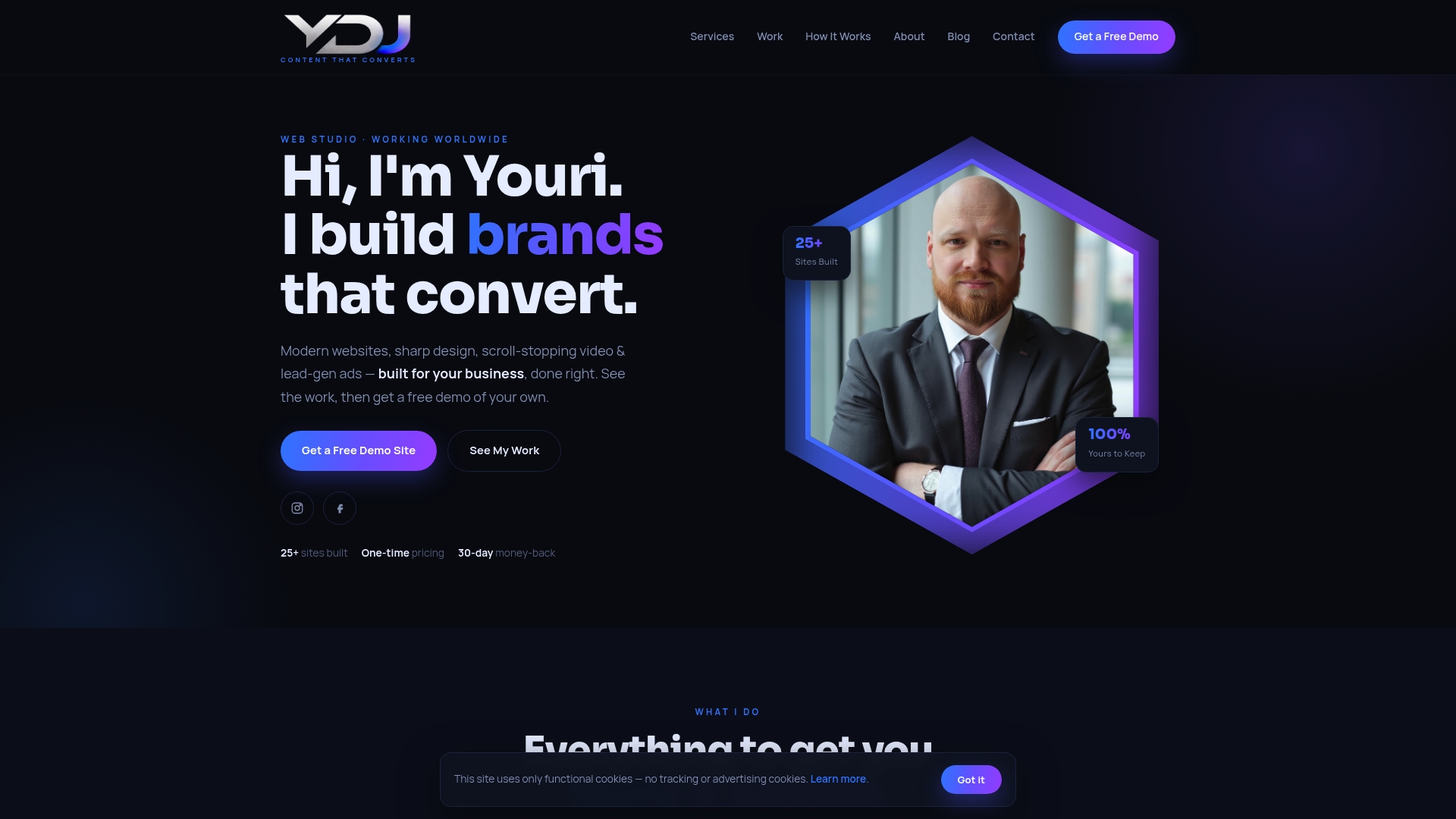
Ydjmedia builds modern, mobile-first websites designed to reflect your brand standards on every page, not just the homepage. From typography and color systems to CTA design and page templates, every element is built for consistency and conversion. You can see your site live before spending a dollar, with a free demo and a 30-day money-back guarantee. There are no retainers and no agency runaround. Just a professional website that looks like your brand, works on every device, and turns visitors into customers.
FAQ
What is brand consistency on a website?
Brand consistency on a website is the uniform use of your visual identity, tone, and messaging across every page. It helps customers recognize your brand instantly and builds trust over time.
How does brand consistency affect revenue?
Companies that maintain consistent brand presentation across all channels can see revenue increases of up to 33%. Recognition builds trust, and trust drives purchasing decisions.
What are the core elements of a consistent brand identity?
A brand identity system includes logo variants, a color palette with exact values, typography rules, imagery direction, and voice and tone guidelines. All five elements need documentation to prevent dilution.
How often should I audit my website for brand consistency?
Run audits quarterly and after any major site change, campaign launch, or team addition. Quarterly reviews catch drift before it becomes visible to customers.
What is the difference between brand consistency and brand rigidity?
Brand consistency defines immutable core elements and allows flexibility within documented boundaries. Rigidity applies identical layouts everywhere, which hurts user experience. The goal is intentional, not identical.