
Startup website conversion optimization is the process of systematically turning website visitors into customers through clear value propositions, streamlined user experience, and data-driven testing. Most startup founders focus on driving traffic, but conversion rate improvements deliver far greater returns. Moving from a 2% to a 6% conversion rate triples your revenue without spending an extra dollar on ads. That shift requires fixing the right things in the right order. This guide gives you a practical framework to do exactly that.
What common website pitfalls undermine startup conversions?
The biggest conversion killers on startup websites are not technical. They are strategic. 24% of early-stage startup sites lack a visible CTA above the fold, and 38% use vague CTA language that fails to motivate action. Visitors who cannot immediately understand what you offer and what to do next will leave.
The most damaging startup website common pitfalls include:
- Vague value propositions. Your hero section must answer “What do you do, who is it for, and why should I care?” in under five seconds. If it does not, you lose the visitor.
- Weak or buried CTAs. Buttons that say “Learn More” or “Submit” do not tell visitors what they gain. Use outcome-focused language like “Get My Free Quote” or “Start My Trial.”
- Mobile neglect. Over 50% of web traffic comes from mobile devices, yet many startups skip thumb-friendly navigation and tap-ready buttons entirely.
- Slow load times. Mobile users abandon pages after just three seconds. A one-second improvement in load time can meaningfully lift your conversion rate.
- Cluttered navigation. Too many menu items scatter visitor attention and pull people away from your conversion goal.
- Multiple conflicting CTAs. When every section pushes a different action, visitors freeze. Decision fatigue is real, and it costs you leads.
Pro Tip: Audit your homepage right now. Read your headline out loud. If you cannot explain what you do in one sentence, your visitors cannot either.
How to design your startup website for conversion optimization?
Good conversion-optimized design is purposeful, not decorative. Every element on the page must support one goal: moving the visitor toward your primary CTA. Aesthetic choices matter only after that foundation is solid.
Follow this sequence when building or redesigning your startup site:
- Write a compelling headline first. The headline is the highest-leverage element to test on any page. If it does not communicate a clear, specific outcome for the visitor, no other fix will compensate.
- Place one primary CTA above the fold. Visitors should see your main action button without scrolling. Repeat it once or twice further down the page, but never compete with secondary CTAs.
- Limit navigation to 5–7 items. Simplified navigation reduces friction and keeps visitors focused on your conversion path rather than exploring dead ends.
- Build for mobile first. Design your layout for a 375px screen before scaling up. Use large tap targets, short forms, and fast-loading images compressed for mobile.
- Address objections on the page. Handling buyer objections upfront can boost conversion rates by up to 80%. Add a short FAQ, trust badges, or testimonials near your CTA to neutralize hesitation.
- Use visual hierarchy deliberately. Guide the eye from headline to supporting copy to CTA using size, contrast, and whitespace. Do not let competing visuals distract from that path.
Pro Tip: Test your site on a real phone, not just a browser emulator. Hidden tap issues and layout breaks only show up on actual devices.
What data and tools do startups need to optimize conversions?

You cannot fix what you cannot measure. Effective conversion rate optimization (CRO) for startups starts with tracking both macro and micro conversions. A macro conversion is your primary goal, such as a purchase or a booked call. A micro conversion is a smaller step along the way, like an email signup or a content download. Tracking both reveals exactly where visitors drop off.
The core data sources every startup needs are:
- Analytics dashboards aligned with your traffic sources and funnel stages. Track where visitors enter, where they exit, and which pages drive the most conversions.
- Session recordings and heatmaps. These show you what real visitors actually do on your pages, not what you assume they do. Rage clicks and scroll depth reveal friction you would never spot in a spreadsheet.
- User interviews. Five to ten short interviews with real customers will surface objections and confusion that no analytics tool can detect.
- A/B testing tools. Use these only when you have enough traffic to reach statistical significance. Running tests without sufficient traffic produces unreliable results and wastes time.
For prioritizing which experiments to run, use the RICE framework: score each idea by Reach, Impact, Confidence, and Effort. This keeps your backlog focused on changes that move the needle rather than cosmetic tweaks.
| Data source | Best used for |
|---|---|
| Analytics dashboard | Funnel drop-off and traffic source performance |
| Heatmaps and recordings | Identifying friction and ignored CTAs |
| User interviews | Surfacing objections and messaging gaps |
| A/B testing | Validating hypotheses with statistical confidence |
What is the step-by-step process for executing conversion improvements?
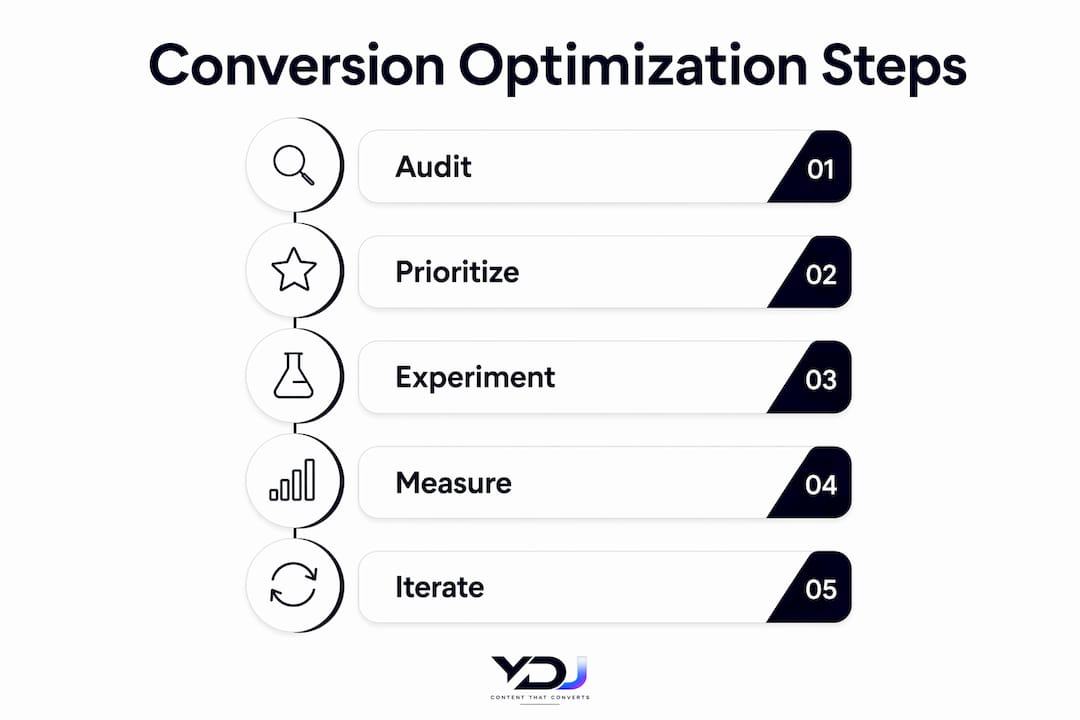
A structured process separates startups that improve steadily from those that make random changes and hope for results. Follow these steps in order.
- Benchmark your current metrics. Record your baseline conversion rate, bounce rate, and average session duration before touching anything. You need a reference point to measure progress.
- Identify your biggest bottleneck. Use your analytics and session recordings to find the single page or step where the most visitors exit. Fix the largest leak first.
- Form a specific hypothesis. Write it as: “If we change X, we expect Y to happen because Z.” Vague hypotheses produce vague results.
- Decide on your testing method. If your site gets strong traffic, run an A/B test. If traffic is low, run user interviews or usability tests instead. Qualitative research uncovers conversion barriers early and costs far less than running underpowered tests.
- Set your sample size before you start. Determine how many visitors you need to reach statistical significance. Do not peek at results early and call a winner. Premature conclusions are one of the most common and costly testing mistakes.
- Implement and monitor. Once a test concludes, apply the winning variant and track its impact on both macro and micro conversions over the following weeks.
- Document everything. Record what you tested, what you changed, and what happened. This institutional knowledge compounds over time and prevents repeating failed experiments.
“The goal is not to run more tests. The goal is to learn faster. One well-scoped test with a clear hypothesis teaches you more than ten rushed experiments with muddy variables.”
Pro Tip: Check your homepage conversion mistakes before running any test. Fixing obvious errors first gives you a cleaner baseline and faster wins.
How do you sustain conversion gains as your startup scales?
One-time fixes do not build a high-converting website. Sustained growth comes from treating conversion optimization as an ongoing practice, not a project with an end date.
The habits that separate high-growth startups from stagnant ones include:
- Documenting every experiment. A shared log of tests, results, and learnings builds a knowledge base that new team members can use immediately.
- Aligning cross-functional teams on shared KPIs. When your design, marketing, and sales teams all track the same conversion metrics, they make decisions that reinforce each other rather than conflict.
- Applying website learnings across channels. A headline that wins in an A/B test often works equally well in email subject lines, ad copy, and onboarding flows. Spread your wins.
- Using behavioral nudges to reduce churn. Onboarding outreach and usage health scoring reduce customer churn, which is itself a form of conversion retention. Keeping a customer is cheaper than acquiring a new one.
- Reviewing micro conversions monthly. Email signups, demo requests, and content downloads signal funnel health before your main conversion rate moves. Catching a dip early saves you weeks of lost revenue.
Pro Tip: Schedule a monthly 30-minute conversion review. Pull your top three funnel metrics, compare them to last month, and identify one hypothesis to test next. Consistency beats intensity.
Key takeaways
Startup website conversion optimization succeeds when you fix your value proposition first, design for mobile, and test with enough data to make reliable decisions.
| Point | Details |
|---|---|
| Fix the value proposition first | Your headline must communicate a clear outcome before any other optimization matters. |
| Design for mobile from the start | Over 50% of traffic is mobile; neglecting it directly costs you conversions. |
| Track macro and micro conversions | Micro conversions reveal funnel leaks before your main metric drops. |
| Match testing method to traffic volume | Use A/B tests for high-traffic pages and qualitative research for low-traffic ones. |
| Document and iterate continuously | A shared experiment log compounds learning and prevents repeating costly mistakes. |
What I’ve learned about conversion optimization that most guides skip
I’ve worked with enough startup founders to see the same pattern repeat. They spend weeks debating button colors and font choices while their homepage headline says nothing specific about who they help or what result they deliver. That is the wrong order of operations entirely.
The single biggest lever in improving startup conversions is messaging clarity, not design polish. A plain page with a sharp, specific headline will outperform a beautifully designed page with a generic one every time. Get the words right first. Then refine the visuals.
The second mistake I see constantly is running A/B tests too early. If your site gets fewer than a few thousand visitors per month, you do not have enough data to trust test results. Founders declare winners after 200 visits and make permanent changes based on noise. Run user interviews instead. Five conversations with real customers will tell you more than a month of underpowered testing.
The founders who build high-converting sites share one trait: they stay curious about why visitors do not convert, not just whether they do. Combine your analytics with real human feedback, and you will always know your next move.
— Youri
Ydjmedia builds startup websites designed to convert
If you have read this far, you already know that a high-converting website requires more than good design. It requires clear messaging, mobile-first structure, and a plan for continuous improvement.
Ydjmedia specializes in mobile-first websites built specifically to turn visitors into customers. The process starts with a free demo site so you can see exactly what your site will look like before spending a dollar. There are no retainers, no agency runaround, and no surprise fees. Just clear, one-time pricing and a 30-day money-back guarantee. If you want a website that works as hard as you do, Ydjmedia is ready to build it.
FAQ
What is startup website conversion optimization?
Startup website conversion optimization is the practice of improving your site to increase the percentage of visitors who take a desired action, such as signing up, booking a call, or making a purchase. It combines design, messaging, and data-driven testing to remove friction from the visitor’s path.
How do I know if my startup website has a conversion problem?
If your bounce rate is high, your CTA click rate is low, or visitors leave without completing any action, your site has a conversion problem. Session recordings and heatmaps are the fastest way to identify exactly where visitors drop off.
When should I run A/B tests on my startup website?
Run A/B tests only when your site receives enough traffic to reach statistical significance. For most early-stage startups, qualitative research like user interviews and session recordings delivers more reliable insights at a fraction of the cost.
What is the most important element to optimize first?
The headline is the highest-leverage element on any page. If it does not communicate a specific, compelling outcome for your visitor, no other optimization will compensate for that gap.
How does page speed affect startup website conversions?
Mobile users abandon pages after three seconds of load time. Compressing images, lazy-loading below-the-fold content, and keeping load times under three seconds are the most direct technical fixes for reducing abandonment and improving conversion rates.