
Your brand identity online is the complete set of visuals, words, and experiences that shape how people perceive your business the moment they land on your website, scroll your social feed, or open your email. It is not just a logo. It is the full picture: how you look, how you sound, and how you make people feel across every digital touchpoint.
The core elements of a strong online brand identity include:
- Logo (including responsive variants for different screen sizes)
- Color palette (a defined set of primary and accent colors)
- Typography (the specific fonts used across all digital materials)
- Brand voice and tone (how you write and speak to your audience)
- Messaging and taglines (the words that capture your value)
- Photography and graphic style (the visual mood of your imagery)
- User experience (how your website and digital channels feel to navigate)
- Positioning statement (what makes you different and who you serve)
When these elements work together as a unified system, your brand becomes instantly recognizable. When they conflict, even slightly, trust erodes fast.
Table of Contents
- Why brand identity online drives real business results
- What are the essential elements of a strong online brand identity?
- Brand identity vs. brand image vs. brand equity: what is the difference?
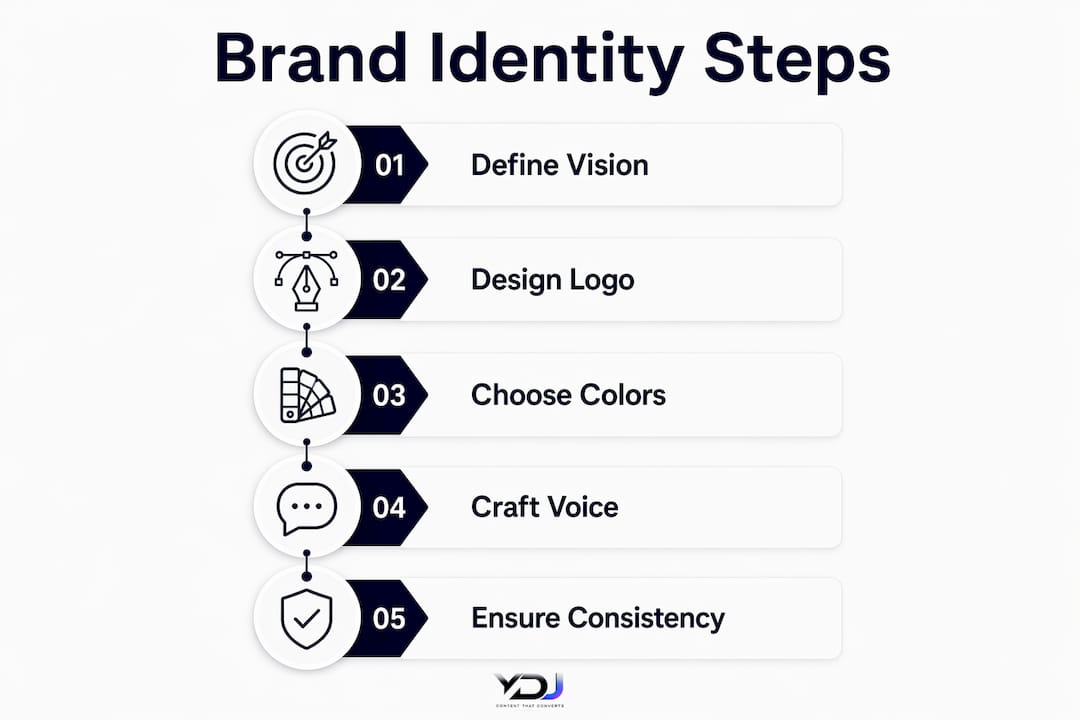
- How to build and strengthen your online brand identity step by step
- Expert insights on managing your digital brand identity
- Key Takeaways
- Ready to put your brand identity to work online?
Why brand identity online drives real business results
Your online brand identity shapes first impressions before a single word is read. A visitor lands on your website and within seconds decides whether you look credible or not. That snap judgment is driven entirely by your visual and verbal identity.

Brand consistency across digital channels increases revenue by 10 to 20 percent, according to published research. This is not a minor gain. It reflects the compounding effect of showing up the same way, every time, so customers know exactly what to expect from you.
The business benefits of a strong digital brand identity go well beyond aesthetics:
- Builds trust with new visitors who have never heard of you
- Differentiates you from competitors in crowded markets
- Attracts top talent and high-value clients who align with your values
- Improves marketing effectiveness because every campaign reinforces the same message
- Drives customer loyalty by creating emotional connections that outlast any single transaction
That gap Professor Avery describes is where most small businesses lose ground. You know what you mean to say. Your customers hear something different. Closing that gap is the whole point of building a deliberate, consistent brand identity online.
What are the essential elements of a strong online brand identity?
A strong online brand identity is built from eight core components: brand voice, logo, color palette, typography, photography style, graphic design style, taglines, and positioning. Each one carries weight on its own. Together, they form a system that makes your brand unmistakable.
- Brand voice and tone: This is how your brand “talks.” Are you direct and confident? Warm and conversational? Your voice should stay consistent whether you are writing a homepage headline or a social media caption.
- Logo design: Your logo is the anchor of your visual identity. It needs to work at every size, from a desktop hero banner to a 16-pixel favicon.
- Color palette: Colors trigger emotion and memory. A defined palette of primary and accent colors keeps your brand visually cohesive across platforms.
- Typography: Font choices communicate personality before anyone reads the words. A bold sans-serif says something very different from a classic serif.
- Photography and graphic style: The mood of your imagery, whether clean and minimal or bold and editorial, shapes how your brand feels to visitors. Service photography directly affects how professional and trustworthy your business appears online.
- Taglines and slogans: A sharp, memorable tagline compresses your value proposition into a phrase people actually remember.
- Positioning statement: This is the internal compass that guides every external message. It defines who you serve, what you offer, and why you are the right choice.
| Element | Function | Example in practice |
|---|---|---|
| Logo | Visual anchor and recognition | Responsive variants for web, app, and favicon |
| Color palette | Emotional tone and consistency | Primary brand color plus 2–3 accent colors |
| Typography | Personality and readability | One heading font, one body font |
| Brand voice | Communication style | Friendly and direct vs. formal and technical |
| Photography style | Visual mood and trust | Clean product shots vs. lifestyle imagery |
| Tagline | Memorable value summary | Short phrase capturing core promise |
| Positioning | Strategic differentiation | Who you serve and why you are different |
The real power comes from treating these elements as a system, not a checklist. Good design works because every visual choice reinforces the same message, so your brand feels coherent whether someone finds you on Google, Instagram, or a referral link.

Brand identity vs. brand image vs. brand equity: what is the difference?
These three terms get used interchangeably, but they describe three very different things. Mixing them up leads to branding decisions that miss the mark.
- Brand identity is what you intend to project. It is the deliberate set of elements you design and control: your logo, your voice, your messaging, your visual style. It lives on your side of the relationship.
- Brand image is what your audience actually perceives. It is the impression that forms in a customer’s mind after every interaction with your brand. You influence it, but you do not fully control it.
- Brand equity is the value your brand has built over time through recognition and loyalty. It is why a customer chooses you over an equally priced competitor, and why your brand name itself carries weight in the market.
Understanding the difference matters because it changes how you approach problems. If customers perceive you as cold and corporate but your identity is meant to feel warm and approachable, that is a brand image problem. If your brand is well-known but customers do not feel loyal, that is a brand equity problem. Knowing which one you are solving keeps your efforts focused.
The Harvard Business School brand identity framework captures this well: brand identity captures the “meaning intent of the firm,” while brand image reflects what consumers actually take away. Aligning the two is the ongoing work of brand management.
How to build and strengthen your online brand identity step by step
Building a brand identity online is not a one-time project. It is a living process. Here is how to do it right.
-
Define your brand purpose and audience. Start with why your business exists and who it serves. Every visual and verbal decision flows from this foundation. If you skip this step, your brand will feel generic because it is not built for anyone specific.
-
Audit your current digital presence. Look at your website, social profiles, email templates, and any existing marketing materials. Identify what is inconsistent, outdated, or missing. You cannot fix what you have not mapped.
-
Develop your visual identity. Create or refine your logo, color palette, and typography. Build responsive logo variants so your mark stays legible from a large desktop display down to a mobile favicon.
-
Define your brand voice. Write down how your brand sounds. Document the tone, the vocabulary you use, and the phrases you avoid. This becomes the verbal half of your brand guidelines.
-
Build a brand style guide. Compile every visual and verbal standard into a single reference document. This is what keeps your brand consistent when you hire a designer, a copywriter, or a social media manager.
-
Apply your identity consistently across all channels. Your website, social media profiles, email newsletters, and digital ads should all look and sound like the same brand. Your website is the one digital asset you fully control, making it the most important place to get this right. Building your brand through your website gives you a foundation that no algorithm change can take away.
-
Monitor how your brand is perceived. Use customer feedback, social listening, and analytics to understand whether your intended identity matches what people actually experience. The gap between intent and perception is where brands lose trust.
-
Adapt and evolve. Digital platforms change. Audiences shift. Your brand identity should stay consistent in its core values while adapting its expression to new formats, new channels, and new audience expectations. Consistent branding online is not about rigidity. It is about recognizable flexibility.
Expert insights on managing your digital brand identity
Digital brand management is fundamentally different from traditional branding. A printed brochure stays fixed. Your online brand identity is interactive, public, and constantly being shaped by real-time customer feedback, platform algorithm changes, and competitor activity.
One of the most common mistakes brands make is treating identity as a finished product. They design a logo, pick some colors, and call it done. But treating brand identity as a living system means developing voice, visuals, and messaging together so they never clash. When these elements are built in isolation, you end up with a brand that looks one way and sounds another.
Reputation management is part of brand identity work too. How your brand responds to reviews, handles complaints, and shows up in search results all contribute to the image customers form. Proactive reputation management is especially critical for service businesses where trust is the primary purchase driver.
Pro Tip: Build a responsive logo system with at least four variants: a full horizontal lockup, a stacked version, a simplified monogram, and a favicon. This ensures your brand stays legible and recognizable at every size, from a billboard-sized hero image to a 16-pixel browser tab.
The brands that hold up over time are the ones that treat every digital touchpoint as part of the same conversation. Your Instagram post, your 404 error page, your email signature: they all carry your brand. Consistency at that level is what turns visitors into customers and customers into advocates.
Key Takeaways
Online brand identity is the deliberate, unified system of visuals, voice, and experience that shapes how customers perceive and trust your brand across every digital channel.
| Point | Details |
|---|---|
| Consistency drives revenue | Brand consistency across digital channels increases revenue by 10 to 20 percent, per published research. |
| Eight core elements | Logo, color palette, typography, voice, photography, graphic style, taglines, and positioning form the foundation. |
| Identity vs. image vs. equity | Identity is what you intend; image is what customers perceive; equity is the value built over time. |
| Your website is your anchor | It is the one digital asset you fully control, making it the most critical place to express your brand. |
| Brand identity is ongoing | Treating it as a living system, not a one-time project, prevents conflicting messages and builds long-term trust. |
Ready to put your brand identity to work online?
You now know what a strong online brand identity looks like and how to build one. The next step is making sure your website actually reflects it. A site that looks inconsistent, loads slowly, or fails on mobile undermines every branding decision you have made.
Ydjmedia builds modern, mobile-first websites designed to convert visitors into customers, with clear one-time pricing and a 30-day money-back guarantee. You can even see your site live before spending a dollar. No retainers, no runaround, just a website that looks like your brand and works for your business.