
What a website content strategy actually is
A website content strategy is a structured framework for planning, creating, publishing, managing, and governing digital content so that every page on your site serves a clear purpose tied to your business goals and your visitors’ needs. Think of it as the blueprint behind your website’s words, images, and videos. Without one, you end up with a collection of pages that might attract traffic but rarely convert visitors into customers.
Content strategy covers the full lifecycle of content: what gets created, why, for whom, when, and what happens to it over time. Harvard Business School describes it as the plan guiding how a company creates and distributes content across text, images, video, audio, and mixed media, all working toward measurable business results.
An effective website content strategy shares these core characteristics:
- Every piece of content connects to a specific business goal or user need.
- The audience is defined before content is created, not after.
- Content types are chosen based on what your audience actually consumes.
- A governance process keeps content fresh, accurate, and relevant.
- Performance is tracked with clear KPIs so you know what is working.
- The strategy is treated as a living document, not a one-time deliverable.
Table of Contents
- How content strategy differs from content tactics and marketing
- What are the core phases of a solid content strategy?
- Seven practical steps to build your own content strategy
- Why alignment across your team, brand, and audience matters
- Content strategy is an ongoing practice, not a one-time project
- Which tools help you build and manage a content strategy?
- Key Takeaways
- Ready to put your content strategy to work?
How content strategy differs from content tactics and marketing
Content strategy and content tactics are not the same thing, and mixing them up is one of the most common mistakes small business owners make. Content tactics are the individual execution tasks: writing a blog post, editing a product description, scheduling a social media update, or recording a short video. Content marketing is the broader practice of using content to attract and retain an audience. Content strategy sits above all of it.

The Nielsen Norman Group puts it plainly: content strategy connects tactical efforts like copywriting, editing, and social media to your business objectives through an overarching framework. Without that framework, you are just producing content and hoping something sticks.
Here is the practical difference:
- Tactic: Writing a blog post about your most popular service.
- Strategy: Deciding that blog posts targeting local search terms will drive qualified leads, then building a publishing calendar around that goal.
- Tactic: Posting a before-and-after photo on Instagram.
- Strategy: Determining that visual proof of results is the most persuasive content format for your audience at the consideration stage of their buying journey.
- Content marketing: Consistently publishing helpful content to build trust with your audience.
- Content strategy: The plan that decides what content gets made, for whom, on which channels, and how success gets measured.
Strategy gives your tactics direction. Without it, even great writing and beautiful design fail to move the needle on revenue.
What are the core phases of a solid content strategy?
A well-built website content strategy moves through seven phases, and they cycle continuously rather than running once and stopping. Research from HubSpot identifies these as the foundational components every plan needs.
- Define your business goals. What do you want your website to accomplish? More leads, more sales, more bookings? Every content decision flows from this answer.
- Build audience personas. Who are your visitors, what do they need, and where are they in their buying journey? Audience awareness levels guide the messaging that resonates at each stage.
- Conduct a content audit. Review what already exists on your site. Assess quality, relevance, and gaps. Identify what to keep, update, repurpose, or remove.
- Select content types. Blog posts, service pages, videos, case studies, FAQs, testimonials. Choose formats based on what your audience actually engages with, not what is easiest to produce.
- Build a production schedule. Assign topics, formats, deadlines, and owners. A realistic calendar prevents the feast-or-famine publishing cycle most small businesses fall into.
- Create and distribute content. Publish on owned platforms first, your website and email list, then distribute across social and other channels. Follow SEO best practices so your content is discoverable.
- Measure and optimize. Track KPIs, review what is performing, and adjust. Setting clear goals and KPIs simplifies this step considerably.
Pro Tip: The most common pitfall is skipping the content audit and jumping straight to production. You almost always have more usable content than you think, and repurposing it is faster and cheaper than creating from scratch.
Seven practical steps to build your own content strategy
Ready to build yours? Here is a step-by-step process you can start today.
-
Define your objectives. Write down one primary goal for your website. Is it generating leads? Driving phone calls? Selling a product? Every content decision you make should pass the test: does this help achieve that goal?
-
Research your audience. Go beyond demographics. Understand what questions your visitors are asking, what problems they are trying to solve, and what stage of the buying process they are in when they land on your site. Tools like Google Search Console and Google Analytics show you exactly what people search for before finding you.
-
Audit your existing content. Pull a list of every page on your site. Score each one: Is it accurate? Does it serve a clear purpose? Is it getting traffic or conversions? This audit tells you where to focus first. For professional service firms, a digital asset assessment is a practical starting point for this phase.
-
Decide your content mix. Not every business needs a blog. A local plumber might get more traction from detailed service pages and video walkthroughs than from weekly articles. Match your content types to your audience’s preferences and your own production capacity.
-
Build a realistic schedule. Consistency beats volume. One well-researched, well-written piece per month outperforms four rushed posts. Use a simple editorial calendar in Google Sheets or a project management tool to track what is in progress and what is coming up.
-
Create and publish with purpose. Every page you publish should have a clear job: inform, persuade, or convert. A service page should answer the visitor’s top questions and include a strong CTA. A blog post should address a specific search query and guide the reader toward the next step. You can see how this plays out in practice with service showcase strategies that tie content directly to business outcomes.
-
Track, learn, and adjust. Review your KPIs monthly. Which pages drive the most leads? Which ones have high bounce rates? Use that data to update underperforming content and double down on what works.
Organizations that skip the strategy step and jump straight to a content plan end up with what content experts call “content chaos”: plenty of traffic, but poor conversion because the content lacks a unified commercial purpose. A guiding strategy is what separates a website that grows your business from one that just exists on the internet.
Why alignment across your team, brand, and audience matters
Content strategy does not live in a single department. It connects your marketing team, your web designer, your developer, and anyone else who touches your website. When those groups work from different assumptions about goals, tone, or audience, the result is a site that feels inconsistent and confusing to visitors.
The Nielsen Norman Group emphasizes that cross-team alignment in messaging and user experience is what produces consistent, engaging websites. Brand consistency across every page builds trust, and trust converts visitors into customers. You can dig deeper into this with Ydjmedia’s guide to brand consistency practices for small businesses.
Getting content strategists involved early in web development also prevents expensive problems. When layout and content are designed separately, you often end up with a beautiful template that does not fit the actual words and images you need to publish. The NNG research is clear: early involvement avoids costly redesigns and ineffective messaging down the line.
Common alignment challenges and how to fix them:
- Inconsistent brand voice: Create a one-page voice and tone guide that everyone writing for your site follows.
- Content created without audience input: Run a simple survey or review customer service questions to ground content in real needs.
- Design built before content is ready: Draft key page content before handing off to a designer, not after.
- No shared goals: Hold a short kickoff meeting where every stakeholder agrees on the website’s primary objective before any content is produced.
Content strategy is an ongoing practice, not a one-time project
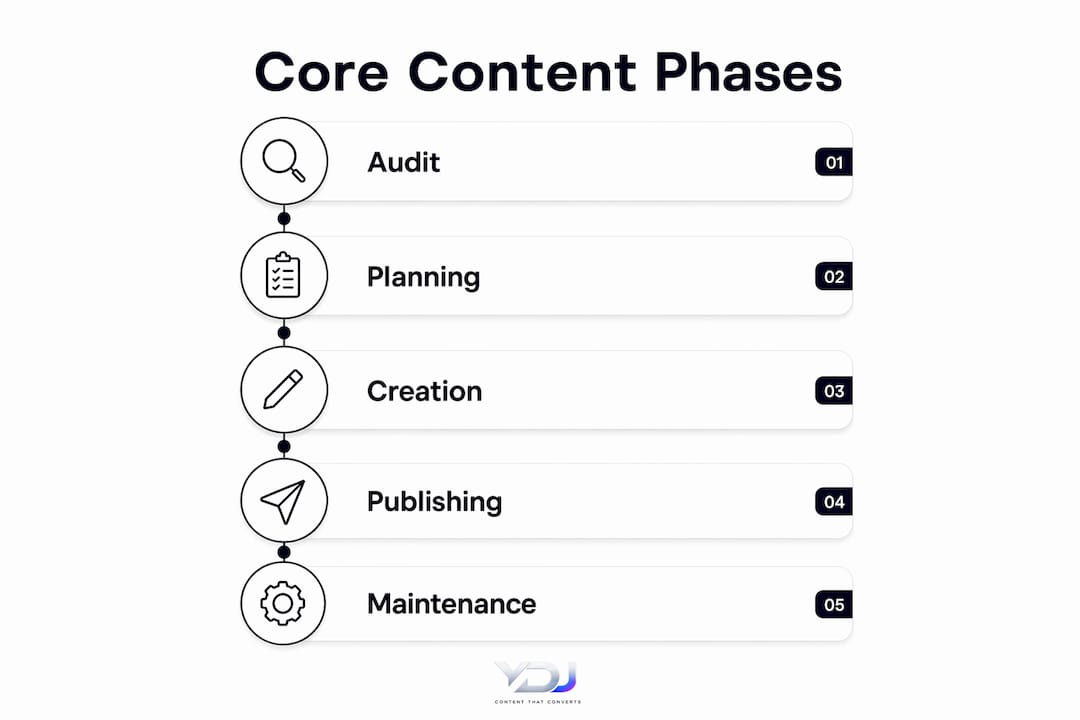
One of the biggest misconceptions about website content planning is that you build a strategy once and you are done. You are not. Content strategy is a continuous practice involving planning, creation, maintenance, and unpublishing phases that cycle repeatedly as your business and your audience evolve.
The governance side of content strategy is where most small businesses fall short. Pages get published and then forgotten. Over time, outdated information piles up, creating what the Nielsen Norman Group calls “content bloat.” This hurts your site’s authority and confuses visitors who land on pages that no longer reflect your current services or pricing.
Key governance practices to build into your process:
- Quarterly content reviews: Check your top pages for accuracy, updated pricing, and current CTAs.
- Unpublish outdated content: Removing pages that no longer serve a purpose is just as important as publishing new ones. Dead content dilutes your site’s overall quality.
- Update high-traffic pages first: Prioritize pages that already get visitors but may have stale information.
- Track content age: Flag any page that has not been reviewed in 12 months for a refresh or removal.
- Monitor search performance: Pages that drop in rankings often signal that the content no longer matches current search intent.
Treating your content strategy as a living system, one that you tend regularly rather than set and forget, is what keeps your website working hard for your business year after year.
Which tools help you build and manage a content strategy?
You do not need an expensive tech stack to run a solid content strategy. The right tools depend on your team size, budget, and how complex your content operation is.
For research and planning:
- Google Search Console shows you which queries bring visitors to your site and which pages rank, making it the most useful free tool for content planning.
- Google Analytics 4 tracks user behavior, bounce rates, and conversion paths so you can see which content actually drives results.
- AnswerThePublic surfaces the questions your audience is asking around any topic, useful for building out a content calendar.
For creation and editing:
- Google Docs remains the simplest collaborative writing tool for small teams.
- Grammarly catches grammar and clarity issues before content goes live.
- Hemingway Editor flags overly complex sentences and passive voice, keeping your writing readable.
For scheduling and project management:
- Trello or Asana work well for managing an editorial calendar and tracking content through drafting, review, and publication stages.
- Notion combines a content calendar, brief templates, and a content library in one workspace, a good fit for solo operators or small teams.
For scheduling and client management in service businesses, tools that handle client scheduling and production workflows can help keep content production on track alongside your other operations.
For SEO and performance:
- Google Search Console (again) is the baseline for monitoring organic performance.
- Ahrefs or Semrush offer deeper keyword research and competitor gap analysis for businesses ready to invest in SEO growth.
Pro Tip: Start with free tools. Google Search Console, Google Analytics 4, and a simple Trello board cover the basics for most small businesses. Add paid tools only when you have outgrown what free tools can do.
For businesses that want to go deeper on content formats, Ydjmedia’s guide to video content for entrepreneurs covers how video fits into a broader content plan and why it tends to outperform static content for service-based businesses.
Key Takeaways
A website content strategy is the structured plan connecting every piece of content on your site to a specific business goal, audience need, and governance process that keeps it effective over time.
| Point | Details |
|---|---|
| Strategy before tactics | Define goals and audience personas before writing a single word of content. |
| Seven core phases | Goals, personas, audit, content types, schedule, creation, and measurement form the complete cycle. |
| Alignment prevents waste | Early collaboration across marketing, design, and development avoids costly redesigns and mixed messaging. |
| Governance keeps it working | Quarterly reviews and unpublishing outdated pages prevent content bloat and protect site authority. |
| Tools match your scale | Start with Google Search Console and a simple editorial calendar; add paid tools only when you need them. |
Ready to put your content strategy to work?
A clear content strategy is only as good as the website it runs on. If your site is slow, hard to navigate, or not built to convert, even the best content plan will underperform.

Ydjmedia builds modern, mobile-first websites designed to turn visitors into customers, with no upfront risk. You get a free demo site to review before you spend a dollar, clear one-time pricing, and a 30-day money-back guarantee. No retainers, no agency runaround.
See what your new website could look like and get your free demo today.