
A personal brand website is a conversion-first online headquarters that answers three questions the moment a visitor lands: who you are, who you help, and what they should do next. It is not a digital resume. It is a sales machine that works around the clock, turning your reputation into inbound leads without you lifting a phone.
Your minimum launch checklist:
- A position statement (one sentence, concise)
- Named-author content that proves your expertise
- A visible track record: case studies, testimonials, measurable results
- A defined scope of services (who you help and what you won’t do)
- One clear CTA on every page
Ydjmedia builds exactly this kind of site for small business owners across the U.S., with a no-risk demo so you can see it live before spending a dollar.
Table of Contents
- Why your personal brand website is your best salesperson
- The four core components every effective personal brand site needs
- What pages to build first and what to put on each one
- Common mistakes that turn your site into a non-converting brochure
- How long it takes and what it realistically costs
- How to get a risk-free, professional site without the usual headaches
- Key Takeaways
- The conversion-first approach is the only one worth taking
- Ydjmedia builds your site risk-free, with no retainer surprises
- Useful sources and further reading
Why your personal brand website is your best salesperson
Most small business owners rely on referrals, social profiles, or marketplace listings. Those channels work until they don’t. A platform can change its algorithm overnight. A referral dries up. Your website, by contrast, is real estate you own.
A clear personal branding site builds trust and discoverability in ways a LinkedIn profile simply cannot match. You control the narrative, the design, and the call to action. Clients who find you through search already trust you before the first call, which shortens negotiations and supports higher rates.
- Positions you as the obvious choice in your niche
- Reduces time spent on cold outreach
- Lets you charge more because proof is visible upfront
- Keeps you independent from any single platform
Pro Tip: Write your homepage copy as if you are speaking to one specific person, not a crowd. “I help Denver contractors book 10 more jobs a month” converts better than “I help businesses grow.”

The four core components every effective personal brand site needs
These four assets are the difference between a vanity site and a compounding sales asset. Skip one and the whole system leaks.
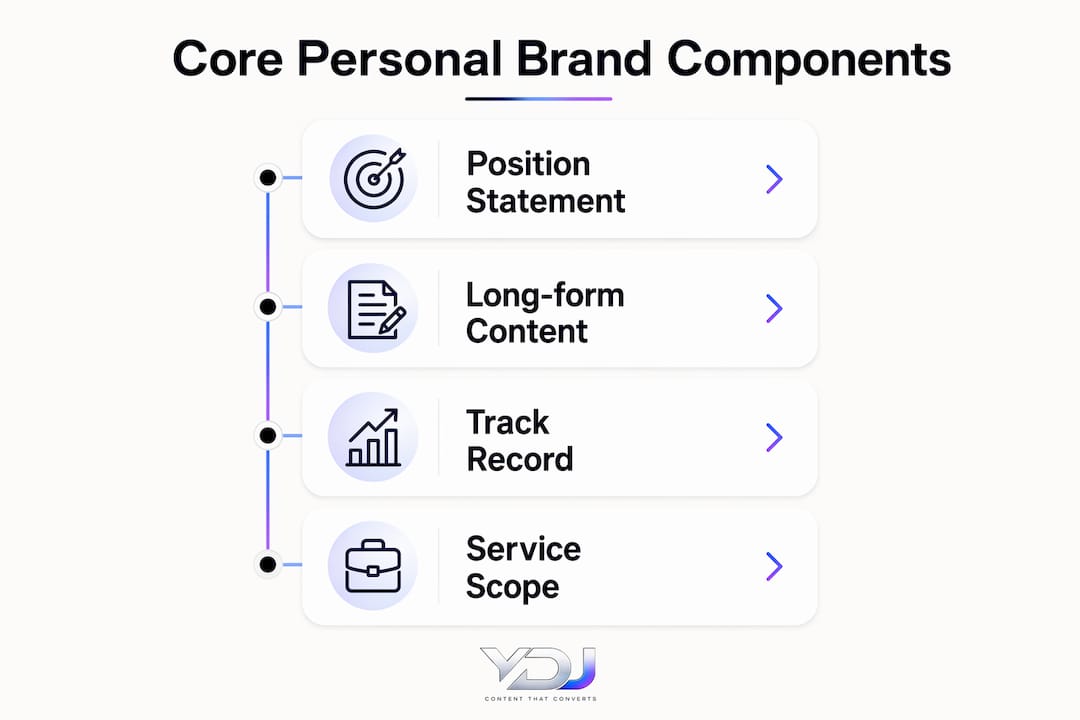
1. A position statement under 20 words
One sentence that tells a stranger exactly who you serve and what outcome you deliver. A narrow position reduces friction for the buyer to self-identify as a fit.
Example: “I help U.S. e-commerce brands cut return rates by 30% through better product photography.”
Mini-checklist:
- Write it in plain English, no jargon
- Test it on someone outside your industry
- Put it in your hero section, not buried in your About page
2. Named-author body of work with multiple long-form pieces
Articles, guides, or case studies published under your name. This is what AI cannot replicate: first-person claims tied to your lived experience.
Mini-checklist:
- Aim for a solid number of pieces before expecting inbound
- Publish on your own site first, then distribute
- Each piece should answer one specific question your ideal client Googles
3. Visible track record
Case studies with measurable outcomes, named clients where possible, and testimonials that describe a specific result. Generic praise (“great to work with!”) does not convert. Specifics do.
Mini-checklist:
- Include several case studies at launch
- State the before, the work done, and the after
- Add a photo or logo where the client permits
4. Defined scope of services
Tell visitors exactly who you help and, just as importantly, who you don’t. Clarity here filters out bad-fit leads and signals confidence to good ones.
Mini-checklist:
- List your core service in one sentence
- Name the client type you serve best
- State one thing you do not do
What pages to build first and what to put on each one
Start with a one-page or small multi-page structure that answers who you are, who you help, and what to do next in five seconds. You do not need ten pages on day one.
| Page | Primary purpose | Must-have elements | Sample headline |
|---|---|---|---|
| Home | First impression + CTA | Position statement, hero image, one CTA button | “I help [audience] achieve [result]” |
| About | Build trust and connection | Your story, credentials, photo, values | “Why I do this work” |
| Services | Convert interest to inquiry | Service name, who it’s for, outcome, price range or CTA | “Here’s exactly how I can help you” |
| Case Studies | Prove results | Before/after, client context, measurable outcome | “Real results for real clients” |
| Blog | Discoverability + authority | Named-author posts, clear categories, internal links | Topic-specific headlines |
| Contact | Remove friction | Simple form, response time promise, phone or email | “Let’s talk — I respond within 24 hours” |
Launch priority:
- Week 1: Home + Contact
- Month 1: Services + one Case Study
- Months 2–6: Blog posts + additional Case Studies
Common mistakes that turn your site into a non-converting brochure
These errors are more common than you’d think, and each one quietly kills leads.
- Vanity listing: Showcasing every project you’ve ever touched instead of filtering content through a sales lens. Do this instead: Show only the three to five projects most relevant to your ideal client.
- Unclear position: Your homepage says “consultant” or “designer” with no niche. Do this instead: Swap it for your 20-word position statement in the hero section.
- Weak CTAs: “Learn more” and “Click here” tell visitors nothing. Do this instead: Use outcome-driven CTAs like “Book a free 20-minute call” or “See how I can help.”
- Missing human voice: Generic, AI-polished copy that sounds like every other site. Do this instead: Write one paragraph in your own words, the way you’d explain your work to a friend.
- Mismatched messaging: Your website says one thing, your LinkedIn says another, your proposal says a third. Quarterly audits keep all three aligned.
Pro Tip: Read your homepage out loud. If it sounds like a press release, rewrite it until it sounds like you.
How long it takes and what it realistically costs
Launching a site is fast. Building a brand that generates inbound leads takes longer.
| Milestone | Realistic timeline |
|---|---|
| Site live (home, contact, services) | 1–2 weeks |
| First 3 case studies published | 4–8 weeks |
| 12–24 named-author long-form pieces | 6–12 months |
| Consistent inbound leads without pitching | 12–18 months |
| Compounding brand effect | 18–24 months |
Pricing approaches:
- DIY builders (Squarespace, Webflow): Low cost, high time investment, often results in a generic look
- Fixed one-time build: You pay once, you own it, no monthly retainer surprises
- Agency-managed packages: Higher cost, faster results, ongoing support
Pro Tip: If your budget is tight, spend it on the build and the copy, not on extras. A clear, fast, mobile-first site with strong copy outperforms a beautiful site with vague messaging every time.
How to get a risk-free, professional site without the usual headaches
Pick the path that matches your timeline and risk tolerance. A risk-free demo and clear one-time pricing remove the two biggest objections most owners have.
Questions to ask any provider before you commit:
- Can I see a demo of my actual site before I pay?
- Is pricing one-time or does it include a monthly retainer?
- Do you offer a money-back guarantee?
- Who owns the site and the content after launch?
- How long until the site is live?
A simple one-page site is a strong trust signal and gives you control over your brand presentation versus relying on Upwork or LinkedIn alone. Launch something real, then build on it.
“A personal brand is what people say about you when you’re not in the room — your website is where you get to shape that conversation before it starts.” — Chad Burmeister
Key Takeaways
A personal brand website works as a conversion asset only when it combines a sharp position statement, named-author proof, and a clear next step for every visitor.
| Point | Details |
|---|---|
| Define your position first | Write a position statement under 20 words before you build a single page. |
| Build proof before traffic | Publish several case studies and multiple named-author pieces to generate inbound leads. |
| Launch small, then expand | Start with home and contact in week one; add services and case studies within the first month. |
| Expect a sustained period for inbound leads to develop | Consistent output for 12–18 months is commonly required before leads arrive without active pitching, and a compounding brand effect is seen at 18–24 months. |
| Ydjmedia offers a no-risk path | Ydjmedia builds mobile-first, conversion-focused sites with a free demo and a 30-day money-back guarantee. |
The conversion-first approach is the only one worth taking
Most personal brand sites fail for one reason: they were built to impress, not to convert. A beautiful site with vague messaging is just an expensive business card. The owners who get real results treat their site as a compounding asset, updating it with proof, sharpening the position, and keeping the CTA front and center.
What I find most overlooked is the messaging alignment piece: your website, your LinkedIn, and your proposals need to say the same thing. When they don’t, buyers sense the inconsistency and hesitate. A quick quarterly audit across all three surfaces fixes this faster than any redesign.
The other thing most guides skip: your human voice is now your biggest competitive advantage. AI can produce polished copy at scale, but it cannot replicate your specific results, your named clients, or your first-person point of view. That is what converts a stranger into a paying client.
Ydjmedia builds your site risk-free, with no retainer surprises
If you’ve read this far, you know what a converting personal brand site needs. The harder question is who builds it without the usual agency runaround.
Ydjmedia creates mobile-first, conversion-focused personal brand websites for small business owners across the U.S. One-time pricing means no monthly fees creeping up on you. A free demo site means you see your actual website live before you spend a dollar. And a 30-day money-back guarantee means the risk sits with us, not you.
Ready to see what your site looks like before you commit? Request your free demo at ydjmedia.com and have a live site in front of you within days.
Useful sources and further reading
Ydjmedia resources:
- Homepage mistakes that cost you clients
- Personal brand website strategy guide
- 9 ways to showcase services online
- Brand consistency best practices
- Portfolio site conversion tips
External research and references:
- Personal branding overview — Interaction Design Foundation
- Building a personal brand website that actually works — Alex Berman
- Personal branding moat for freelancers — Delivvo
- How to build a personal brand as a freelancer — School for Freelancers
- Managing your freelance personal brand — Gruv AI